
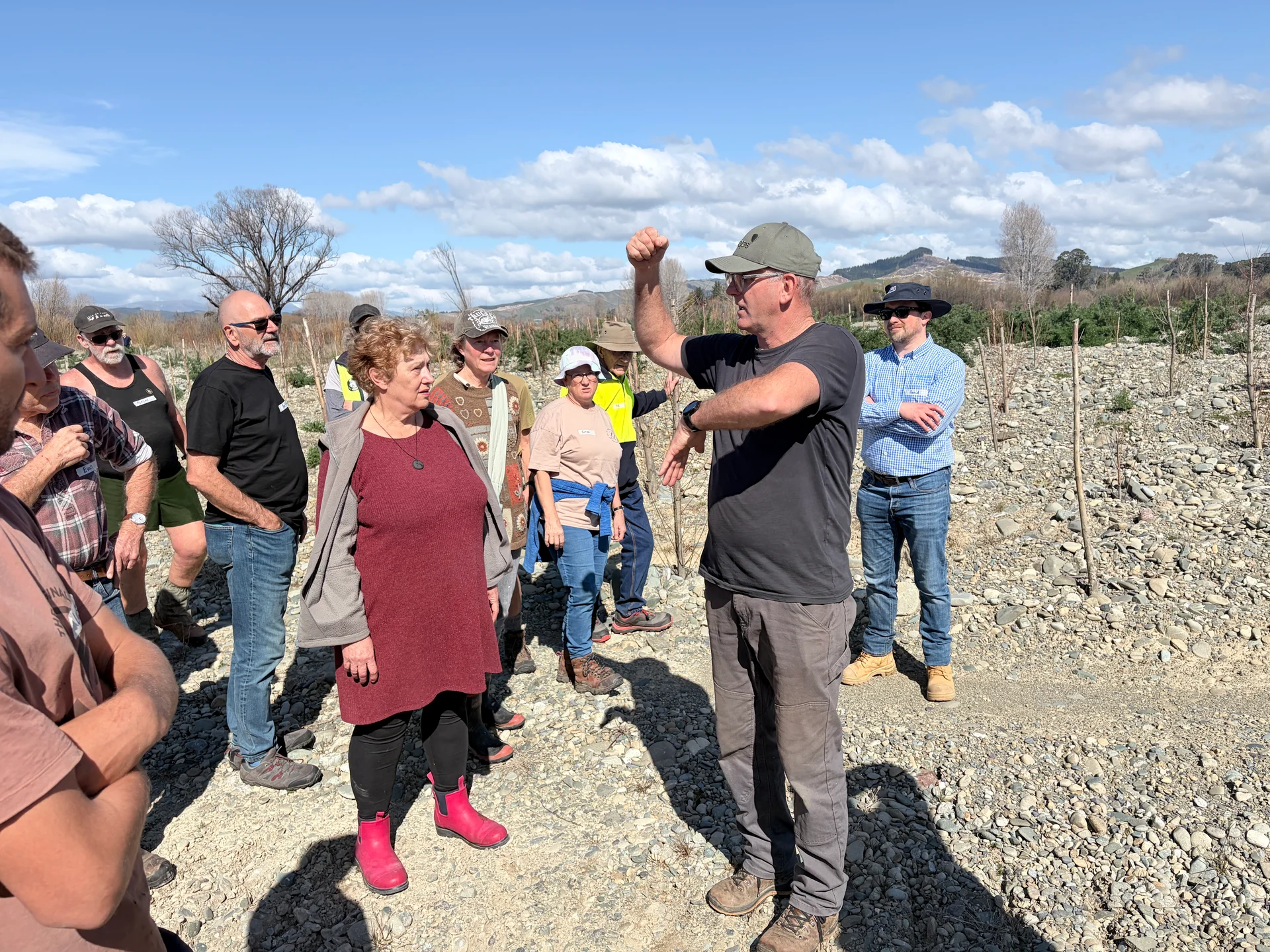
Dean Palmer from Hinetai Hops hosted a field trip recently, showing how his willow plantings and other flood management actions helped during the 2025 Tasman floods.
Twenty-four landowners, from a range of rural and riverside properties converged on the Motueka Valley Highway property in Tapawera to attend the Planting for Reducing Flood Impacts event on Thursday 3 September.
The session included practical demonstrations, so attendees would leave with a clearer idea of what could work on their own properties and who to talk to first.
Dean explained about his approach and experience with the management of part of his land and its core function in mitigating flood debris impacts and stopping this from entering his hop farm, rather than solely focusing on the water.
"You can't stop the water — but you can stop the debris that does the damage,” Dean said, when talking about his willow plantings at Hinetai Hops.
Dean owns riverside land he can retire from productive use and use it as a buffer between the Motueka River and his hop farm.
He also shared about his hard-won lessons on planting angles, closing debris gaps, and letting the grass grow rank (tall, thick and coarse) to give attendees plenty of food for thought.
“Planting on an angle relative to flow matters,” Dean explains.
“Make sure there are no large gaps between the rows. Overlap them so that debris can’t get through a hole.”
Dean shared his planting approach and survival, including his experience with different varieties and techniques, destocking and growing grass cover, flood behaviour observations, maintaining his willow plants and keeping them healthy.
His presentation included a site walk over to view and discuss flood management plantings.
Helen Forsey (Tasman District Council Catchment Advisor), Eric Appleton and Jacky Friedman (Appleton's Tree Nursery), and David Arseneau (Tasman District Council Rivers and Natural Hazards Manager) also provided valuable insights.
Helen gave a rundown of Tasman District Council rules and who to call when landowners are looking to do plantings for flood protection.
Eric and Jacky explained the role of root structures, planting techniques, along with picking the right poplar and willow varieties based on their experiences running a nursery.
They also provided free willow and poplar poles to attendees, from Appleton’s Tree Nursery.
David Arseneau explained how Tasman District Council is scaling up its own riverside planting programme.
Dana Carter from Motueka Catchment Collective summed up the recurring themes from the event, they planned and delivered following a flood risk workshop in Tapawera in May.
“One thing that came through loud and clear is that willows aren't the answer everywhere,” she said.
“They're brilliant because they're so easy to establish and grow fast — but that same trait makes them weedy, so they're a poor choice near ecological or restoration sites downstream, where even the newer varieties can spread.”
“Natives are the better call there, just on a longer timeframe.”
The idea for the event is that the community can learn from each other.
“Peer to peer learning is often very effective in rural communities,” Dana says.
“But our event also included other aspects the community needs to know - best practice planting technique and species choice, through to right tree right place principles, as planting can affect the catchment downstream.”
