
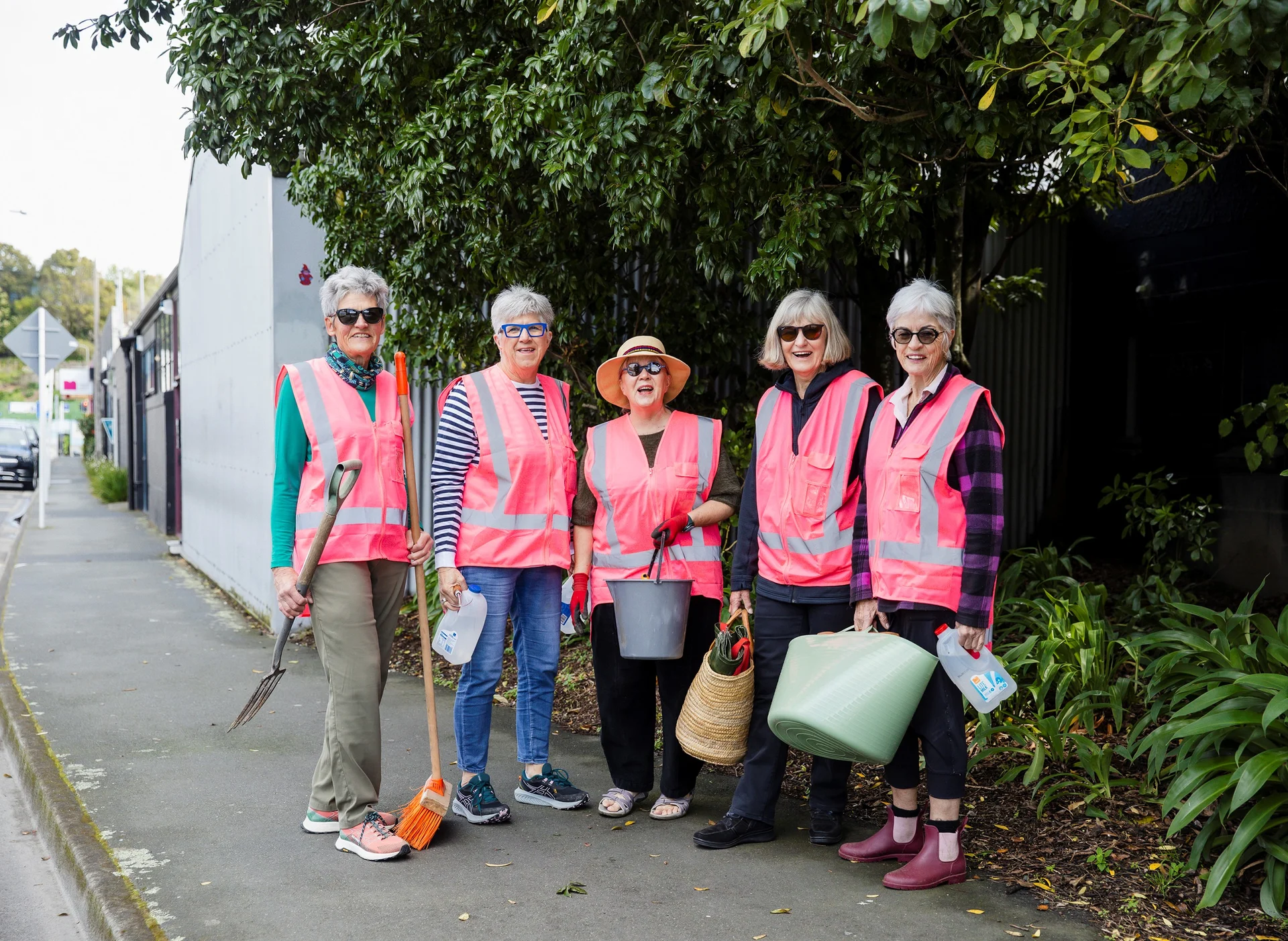
Armed with secateurs, seedlings, water bottles and a healthy dose of civic pride, a small group of Nelson women is proving that making a city better can begin with something as simple as tending a forgotten patch of dirt.
Words: Adrienne Matthews | Photos: Tessa Claus
The Angel Gardeners grew out of Make/Shift Spaces’ 2024 Spring Clean campaign, an initiative aimed at tidying up and breathing new life into parts of Nelson’s central city. Make/Shift Spaces was founded in 2019 by Anne Rush MNZM, at a time when the city centre was grappling with a high number of vacant shops and considerable public negativity about its future. With a background in the arts, Anne believed creativity could help bring fresh energy back into the city, and the Spring Clean campaign was one of the ideas that emerged from that thinking.
“I believe that the places we live in are shaped not only by councils, planners and property owners, but by ordinary people who care enough to become involved,” she says.
During this campaign, a problem became obvious. Nelson has a surprising number of small garden beds, planters and pots that seemed to belong to nobody in particular. Some had originally been established by businesses or property owners but had gradually fallen into neglect, while others sat in awkward areas where it was unclear who should be looking after them.

An idea emerged to form a group that would re-energise Nelson’s “lost gardens.”
Anne’s sister, Cathy O’Malley, is one of the organisers of the group. “We are careful about where we intervene,” she explains. “These are not generally council gardens and the group does not want to take over work that belongs to contractors or landscapers. “Instead, we look for those odd little spaces where nobody appears to be taking responsibility and where a modest amount of effort can make a noticeable difference. It is always very exciting when we discover another sad space that needs beautifying.”
All across the city are signs of these patches of nurtured treasure and the handiwork of the intrepid team that tend them. At least once a week they gather together and go to work.
There are several such gardens along Halifax Street, including the beds outside the library and another on the former petrol station site across the road. One of the Angels’ more challenging projects has been affectionately named the “Two Rock Garden” because, when they first discovered it, that was essentially what it contained: two rocks and two Renga Renga lily plants.

“The position beneath the eaves of a building means very little rain reaches it and the soil is far from ideal, so finding plants capable of surviving there has been an ongoing experiment,” explains Cathy. Succulents appear to be winning the battle, with many sourced from other large pots around the city and propagated by members of the group. She laughs that the Angels have become very deft at “robbing Peter to pay Paul,” taking cuttings and divisions from plants that are thriving and using them to establish new gardens elsewhere.
Watering can require similar ingenuity. Accessible taps in the central city are surprisingly difficult to find, so some of the women carry large bottles or containers of water in their cars and stop to water gardens when they happen to be nearby. Finding a previously undiscovered tap has become, Cathy jokes, a source of considerable excitement.
Angel Gardener team member Shelagh Noble is one of those who carries water. Having moved into an apartment in central Nelson, she no longer has a substantial garden of her own and says the Angels provide an enjoyable opportunity to get her hands back into the soil.
She is quick to point out that some members have far greater gardening knowledge than she does, particularly the women who propagate plants and help decide what will suit particular locations, but she is very happy to be what she calls “an extra pair of hands.” The relaxed nature of the group is one of its attractions. There is no requirement to attend every outing; people simply join in when they are available, which makes volunteering manageable rather than another obligation.
That sense of enjoyment matters because the Angel Gardeners have become as much a social group as a gardening one. Cathy worked in the health sector before retiring and has always enjoyed gardening, and she says the outings are a chance for women with similar interests to spend time together while doing something useful. Coffee features fairly prominently as well.
The benefits, however, extend well beyond the gardeners themselves. One of the most interesting consequences has been the way improving one small space can encourage other people and businesses nearby to take greater pride in their surroundings.
Selwyn Place is an excellent example. Property owner Gaire Thompson supported the planting of gardens there after earlier landscaping had been damaged and vandalised. When Make/Shift Spaces approached him with a new plan, he was happy to give it another chance and paid for the plants.
“It’s been successful, so we’re pleased about that,” he says, adding that gardens provide a welcome contrast to expanses of concrete and paving.
The idea that when an environment looks cared for, people are more inclined to respect it, is well understood by landscape architect Janine Riley of RMM Landscape Architects, whose team contributed expertise and practical help during the original Spring Clean. Through industry contacts, plants and materials were sourced, while businesses including Mitre 10 provided compost and other support. RMM also allowed staff time to be spent on the project.
Five members of the team worked on gardens including the area outside the Nelson English Centre. The work was not glamorous. Rubble and rubbish had to be removed, poor soil improved and hardy plants found that could cope with difficult urban conditions and irregular watering.
At a former petrol station site, the planting became an eclectic mix of whatever suitable material could be sourced towards the end of the growing season. Among the survivors are artichokes, which have performed so enthusiastically that they are now self-seeding.
For Janine, the success of these projects highlights the importance of what landscape architects sometimes call “cues to care.” Small areas that are obviously looked after can influence the way people perceive an entire place.
“If you have tidy edges or little pockets of well-cared-for things, it creates quite an impression on a town,” she says. In her view, the Angel Gardeners are demonstrating very visibly that people care about Nelson and want it to feel vibrant and welcoming.
Once that care becomes visible, it can spread. Along Selwyn Place, businesses began improving their own properties. Buildings were repainted, Make/Shift Spaces introduced artworks on doors and windows, and the whole environment began to change. Anne believes one improvement often prompts another because people look at what is happening next door or across the street and start thinking about what they might do themselves.
She has seen the same effect elsewhere. During work in New Street, two property owners became involved and subsequently decided their own landscaping needed attention, investing thousands of dollars in upgrading it. The community project had not paid for that work; it had simply provided the prompt.
Graeme Page, manager of Nelson Taxis has watched a similar change take place around the business. When the company joined the Spring Clean, it was already thinking about how it presented itself and how it might introduce a younger generation, more familiar with Uber, to the long history of Nelson taxis. The business repainted its exterior and became part of the wider beautification effort.
Graeme admits he was initially doubtful about whether new gardens would survive but is thrilled with the result and the support from the Angel Gardeners and the way it has encouraged others to contribute.

“A McDonald's employee comes along and picks up rubbish and our early morning drivers do the same. It’s great to see the pride people are taking in it.”
Graeme believes there is something refreshingly traditional about it. “We tend to expect the council to do everything, but in actual fact, this is the old-fashioned way where everybody pitches in and helps,” he says.
That observation comes close to explaining why the Angel Gardeners have struck such a chord.
At Nikau House in Nile Street the Angels visit regularly to help care for the courtyard garden, which had become rather neglected. It has an established grapevine and good bones but needed attention. Plants propagated or divided from elsewhere have gradually been introduced.

The result is now a much more welcoming retreat for people who use Nikau House, some of whom join the gardeners when they visit. The project has therefore become as much about people as plants, with gardening providing an easy, practical way to spend time together and create something worthwhile.
For Anne, that interweaving of people is fundamental to the way a healthy city works. “Nelson is made up of property owners, businesses, artists, volunteers, community organisations, developers, cultural groups, hospitality operators and many others, all contributing different layers to the life of the city. The more those people communicate and work together, the stronger the whole becomes,” she says.
A city becomes a better place to live when enough people feel that they have a stake in it, and when caring about their surroundings leads to action rather than complaint. Nelson’s Angel Gardeners are showing that no contribution has to be grand to matter. When one person begins looking after a neglected corner, somebody else notices, then another person joins in, and slowly the sense that a place is cared for begins to spread.

Perhaps the most important thing the Angel Gardeners are cultivating is not plants at all, but pride in the city they call home.
For those interested in donating time or money please contact Anne Rush, Ph 021 220 7441
