
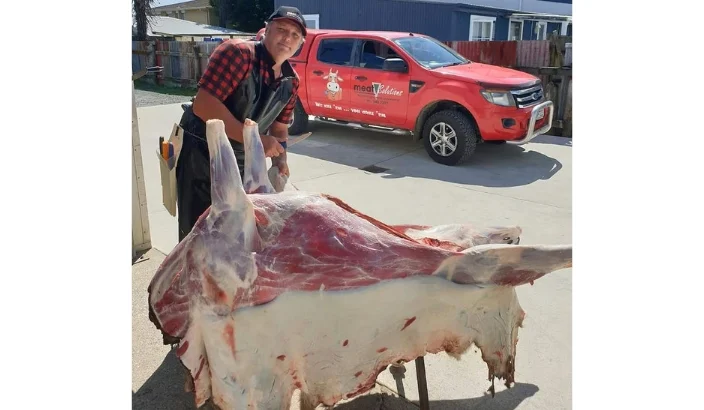
Federated Farmers is supporting the removal of the 28-day homekill ownership rule, but says it should be replaced with targeted safeguards rather than an arbitrary ownership period.
The Ministry for Primary Industries is consulting on whether people should still have to own and care for an animal for at least 28 days before it is slaughtered as homekill.
The review also covers who can consume homekill and recreational catch, and whether additional labelling requirements should apply.
Federated Farmers rural butcher co-chair Andrew Hudson says the current rule is the wrong tool for managing the risks associated with homekill.
“For a lot of rural families, homekill is simply a practical and affordable way of putting food on the table,” Andrew says.
“It provides a way for rural people to feed themselves, their families and those around them.
“People also have relationships with farmers, and they may want to buy an animal and have it processed.
“It doesn’t make much sense to say ‘yes, you can do that, but only after you’ve owned the animal for 28 days’.”
Andrew says legitimate concerns about food safety, animal welfare, biosecurity, livestock theft and illegal meat trading need to be addressed, but the ownership period does not necessarily achieve that.
“If those are genuine risks, they should be managed directly. Putting an arbitrary clock on how long someone has owned an animal doesn’t necessarily make that animal safer, or the meat safer.”
Federated Farmers says the rule may also disproportionately affect people trying to follow the law.
“Someone stealing livestock or deliberately trading homekill meat illegally is pretty unlikely to care about following the 28-day rule,” Andrew says.
Instead, Federated Farmers says any replacement should focus on who can participate, how animals are transferred and who can process them.
The organisation’s Rural Butchers group says there should be a clear connection between the animal, the farmer and the person ultimately consuming the meat, with appropriate traceability.
Its preferred pathway would be limited to the farmer, the end customer and a listed homekill service provider.
The group says that would preserve direct farmer-to-customer arrangements while reducing the risk of homekill becoming an anonymous online marketplace.
Federated Farmers rural butcher co-chair, and Tasman butcher James Fairbrass, says the distinction between homekill and a regulated meat market must remain clear.
“We’re not at all asking for homekill meat to be able to be sold through the back door,” James says. “That line needs to stay very clear. If meat’s being sold commercially, it should be going through the appropriate food safety controls.
“We don’t want to see someone sitting in Auckland buying an animal online, never seeing it alive, and then having unregulated meat delivered to their door.”
The organisation says safeguards could include clear labelling and traceability, limiting processing to listed homekill service providers, and introducing minimum standards for those operators.
Those standards could sit within the Ministry for Primary Industries and New Zealand Food Safety framework, or potentially be developed as an agreed industry standard.
James says the review is also an opportunity to look at the wider regulatory environment facing rural butchers and improve access to legal, locally processed meat.
“One of the big issues is there aren’t enough options for farmers who want to have animals processed locally and legally sold,” he says.
“Micro and mobile abattoirs could provide that pathway, but the cost and regulatory requirements can make it really difficult for small operators to get up and running.”
Micro and mobile abattoirs provide a regulated pathway for locally processed meat to enter the domestic market.
These operators currently make up a relatively small part of the sector but could play a larger role in future.
Rather than competing with homekill, the Rural Butchers group sees regulated local processing and homekill as complementary pathways that can help address wider access-to-processing challenges in rural communities.
James says the Government should consider how to make the regulated pathway more accessible to small operators.
“If someone wants to take the next step and process meat legally for sale, we should be making that easier, not harder,” he says.
“We need a system that works for a small rural butcher, not just a large processing plant.”
Federated Farmers says the 28-day rule should be removed, but not replaced with a free-for-all.
Instead, it says the Government should use targeted rules to manage the risks associated with homekill.
Submissions on the Government’s consultation close on 5 October 2026.
