
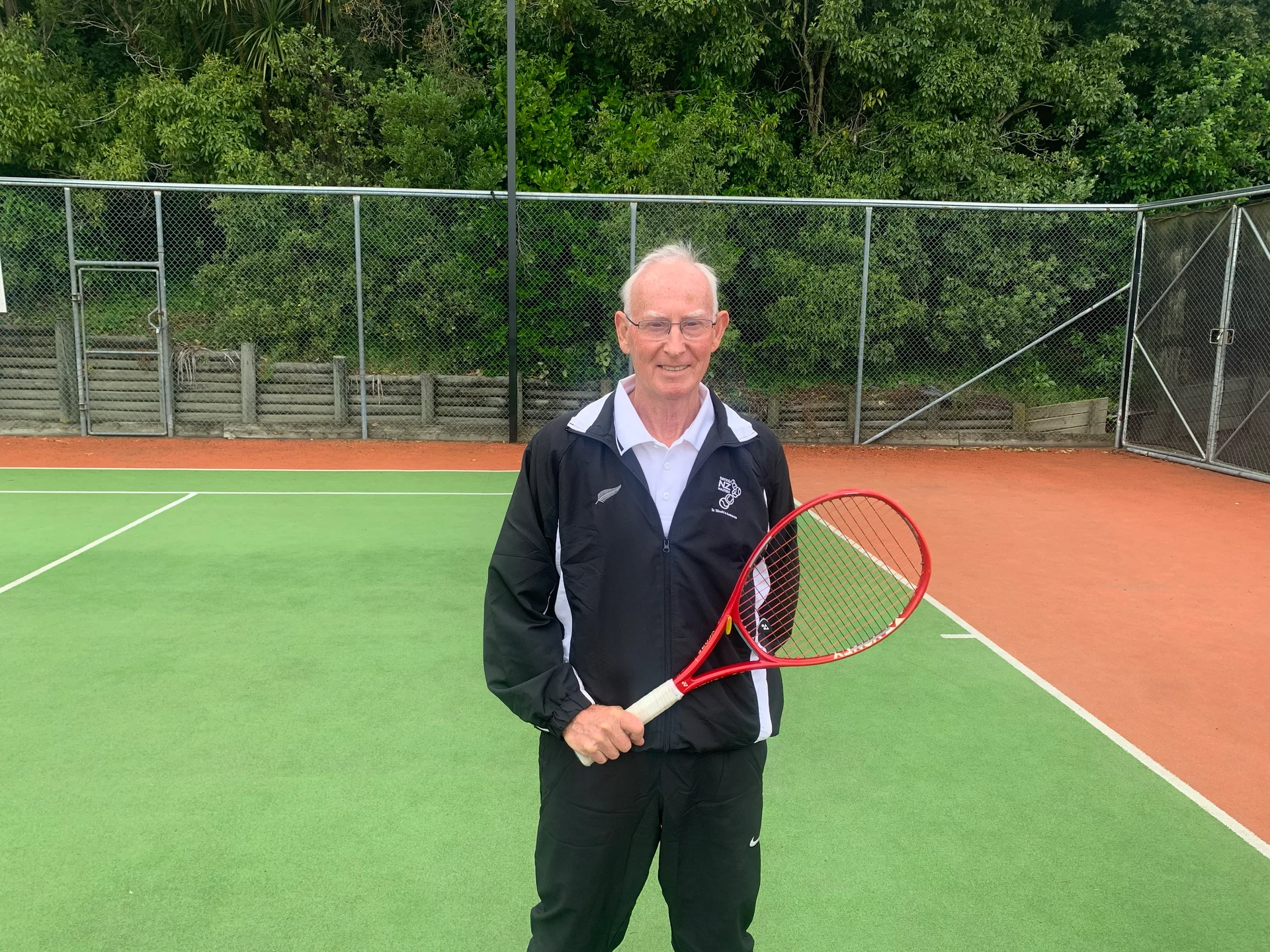
Preparation was all important for Nelson tennis player Geoff Nalder ahead of the World Masters 75+ tournaments which started in Crete this week.
The longtime Tahunanui Tennis Club member went to the corresponding event in Croatia last year and found playing on clay very different to what he was used to.
“It was my first time, a great experience, and there was a good atmosphere within our team, but it was tough going. We finished 19th out of the 26 teams,” says Geoff.
So, the 76-year-old has invested in more suitable rackets for the clay surface this time and made sure he got to the Greek Island early to get some practice in.
“I have had plenty of time to think about my game and especially the bounce of the ball,” says Geoff, before heading off as a part of the New Zealand team of four men and four women.
The forehand is his strength, which will be fully tested over the team and individual competitions.
“There were 165 in the men’s singles last year and the level of play is so high compared to New Zealand. I watched the 80+ singles and some of those guys were quite amazing,” enthuses the former butcher.
“When my business closed I was going through a tough time, but I got back into tennis at Tahuna and it was great. With two of my brothers and a nephew, we formed a team,” says Geoff, who went on to work as a caregiver for people with intellectual disabilities.
Geoff grew up in Golden Bay and won the U18 singles title at Pōhara as a 15-year-old before moving to Nelson to take up his apprenticeship.
He then turned his sights to rugby with the Stoke club.
“I played most positions in junior rugby and ended up on the wing because I could run fairly fast.”
He’s not quite so quick these days but still plays in the local interclub competition which began last week.
“Everyone my age has injuries. I have a bit of a back issue.”
While in Crete, Geoff is hoping to check out New Zealand’s military involvement there during the Second World War.
The 2nd New Zealand Expeditionary Force, of over 7,000 troops, was a big part of a composite Commonwealth division that tried to defend the island against a huge German airborne invasion in May 1941.
Major-General Bernard Freyberg VC commanded the more than 40,000 troops which were heavily outnumbered and under resourced in the 12-day battle, which ended when they were eventually forced to retreat.
Bernard was among the survivors and went on to become the seventh Governor-General of New Zealand, the first to be raised and educated in this country.
