
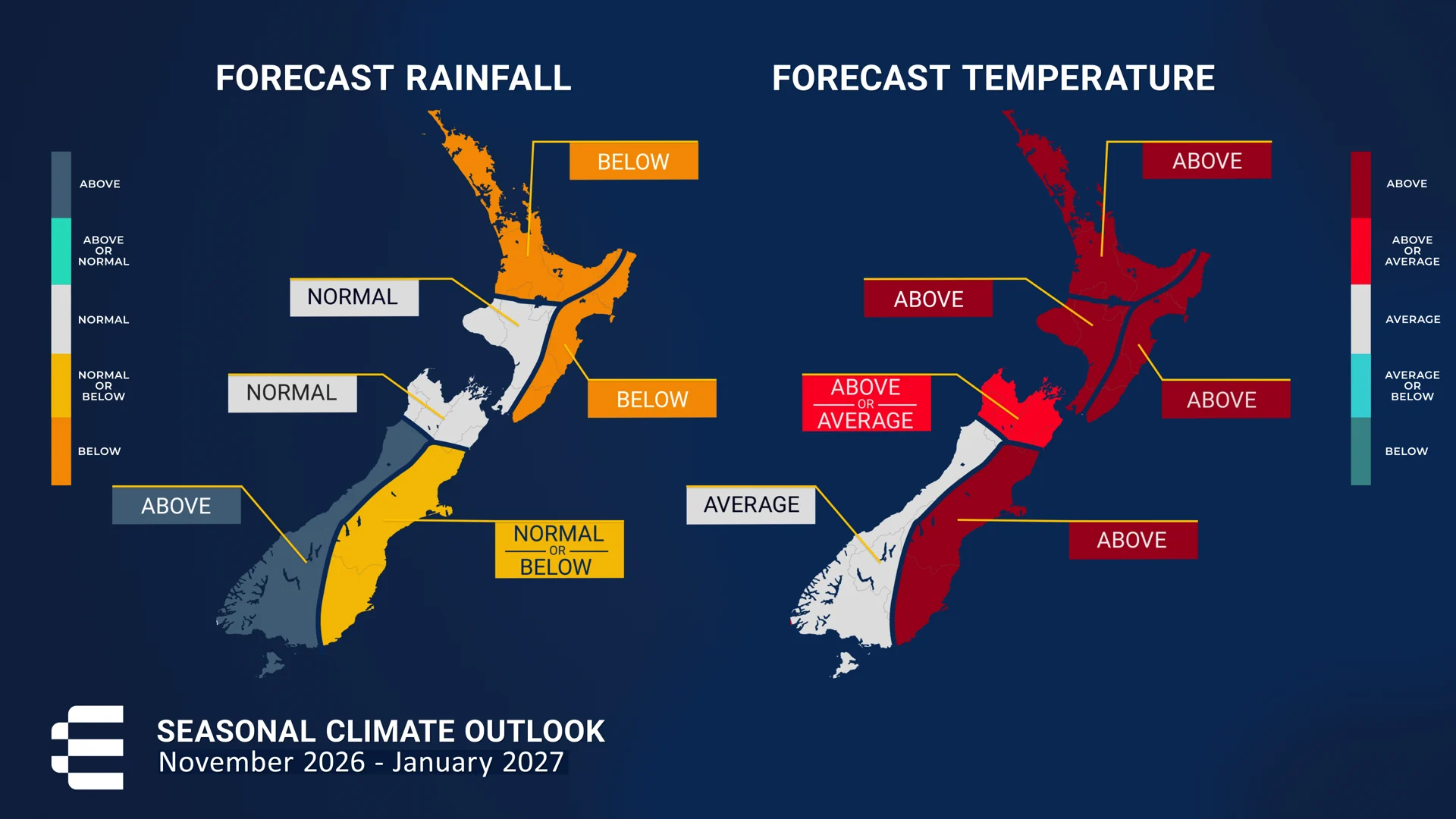
A strong El Niño is expected to bring a summer of weather contrasts to Nelson Tasman, with forecasters predicting near-normal rainfall overall but noticeable differences between the region's western and eastern areas.
The latest seasonal outlook from Earth Sciences New Zealand covering November 2026 to January 2027 says temperatures in Tasman, Nelson, Marlborough and Buller are most likely to be near average, although warmer-than-average conditions are also a strong possibility. Forecasters say residents should expect bigger temperature swings than usual through the season.
Rainfall totals across the wider region are most likely to be near normal, with a 40% chance of that outcome. However, scientists say there is considerable uncertainty in the forecast, with wetter conditions favoured in western areas and drier conditions more likely in the east.
Soil moisture levels and river flows are equally likely to be near normal or below normal during the three-month period. Both outcomes carry a 40% probability.
The outlook is being shaped by what forecasters describe as a very strong El Niño in the tropical Pacific. They say the event has intensified during October and is expected to remain the dominant driver of New Zealand's climate through summer.
A prevailing pattern of northwesterly, westerly and southwesterly winds is expected, bringing periods of unsettled weather at times, particularly to the South Island.
Nationally, the strongest dry signals are focused on the north and east of the North Island, while wetter-than-normal conditions are favoured for the far south and west of the South Island.
The outlook also notes marine heatwave conditions have recently developed in the Nelson-Tasman region, although these are not expected to persist. Coastal sea surface temperatures around the northern South Island were running about 1.02C above average in late October.
Forecasters rate confidence in the temperature outlook as medium and confidence in rainfall forecasts as medium-low because rainfall outcomes will depend heavily on the balance between westerly and southwesterly weather patterns through summer.
