
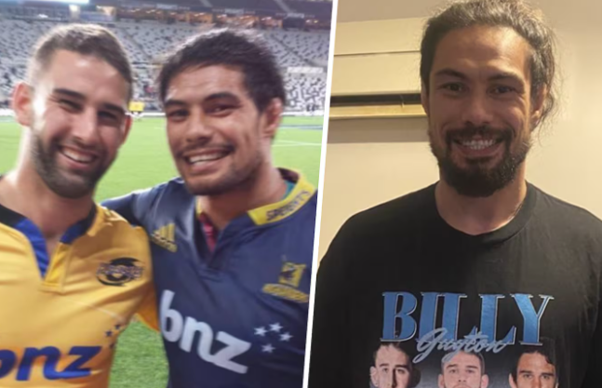
The deaths of Shane Christie and Billy Guyton will trigger a far-reaching inquiry into rugby’s concussion record after a coroner today challenged New Zealand Rugby’s handling of evidence and ordered the release of more than 1000 documents. David Fisher of the New Zealand Herald reports.
The coroner investigating the deaths of former rugby players Shane Christie and Billy Guyton has expressed frustration with New Zealand Rugby’s handling of evidence, ordering it to hand over 1091 documents it had dismissed as irrelevant.
Coroner Ian Telford told New Zealand Rugby (NZR) he was “starting to lose patience” over the national sporting body’s efforts to locate and disclose records relating to the two players and what it knew about concussion risks.
Telford has ruled that the two deaths will be heard as a joined inquest and has ordered NZR to produce documents it had previously excluded, including concussion research, strategy papers and board minutes.
The decision sets the stage for an examination of rugby’s historical handling of concussion, including what its governing body knew about the risks of repeated head impacts, when it knew, what action it considered and what it actually did.
Christie, 39, a former Highlanders and Māori All Blacks loose forward, died in August 2025. Guyton, 33, a former Māori All Blacks and Super Rugby halfback and a close friend of Christie, died in May 2023.
Both deaths were reported as suspected suicides and post-mortem examinations found chronic traumatic encephalopathy (CTE), a degenerative brain disease associated with repeated head impacts.
A 2025 review of 18 studies found an association between concussion and increased suicide risk. Depression, behavioural changes and suicidal thoughts have been reported in people subsequently diagnosed with CTE, although scientists have yet to establish whether the disease itself increases suicide risk.
NZR’s lawyer Tanzam Hossain told the court it had already provided more than 6000 documents across the two inquiries, which will now be merged into a joint inquest.
But lawyers for the families and counsel assisting the coroner challenged the scope of its searches and its decisions to exclude potentially relevant material.
“This inquiry is going to be one that the world looks at,” lawyer Daniel Kalderimis, KC, told the coroner, pointing to an article about Christie and Guyton published by The Athletic, the sports publication of the New York Times.
Kalderimis, representing the Guyton family, pointed out that NZR had told The Athletic in September 2025 that staff from the organisation and the New Zealand Rugby Players Association had met with and supported current and former players, including Christie and Guyton.
But when it came to identifying those staff for the coroner, he argued NZR had largely supplied a list of names and contact details rather than taking steps to obtain and produce relevant information.
“So they were able to say to the New York Times … our staff did provide support. But now they say, we don’t know. Here’s just a list of people,” Kalderimis said.
He said it was critical for the inquest to establish NZR’s approach to concussion management at the time the men were playing, rather than relying on its current policies.
“Was there a precautionary approach? If so, what did it look like? And how was it manifested? Who did it?”
Kalderimis accused NZR of failing to search text messages despite the issue having been raised at an earlier hearing. “They simply have not been searched,” he said.
He also criticised searches of NZR computer systems that included Billy Guyton’s first name but not his surname alone, and said NZR had generally excluded documents created after Guyton’s death in May 2023, despite supplying its own more recent concussion policies.

Kalderimis criticised the approach to material created after Guyton’s death. “You can’t only provide the good stuff after that date.”
Hossain defended NZR’s search process, saying electronic searches were the most practical way to locate historical records, particularly given staff turnover. She said the organisation had provided the court with the search terms it used.
But Telford questioned how the court could be expected to specify precisely which documents NZR should search for when it had no way of knowing what records the organisation held.
“How can I possibly know what you’ve got on your computers in New Zealand Rugby?”
Telford made clear he wanted the wider disclosure exercise revisited. “It would seem to me that the best way forward is for this exercise to be done again and to be done completely.”
He also told Hossain: “It’ll come as no surprise to you that I’m starting to lose patience with this exercise.”
NZR had produced just 39 documents from the search, having identified and reviewed a further 1091 that it assessed as irrelevant.
Those excluded documents included research papers, studies, proposals, strategy material and board minutes relating to concussion management.
Telford ordered they be produced, saying the inquiry went beyond establishing what concussion policies were in force when Christie and Guyton were playing.
It would also examine what NZR knew and understood about concussion risks, what information was available to it, what options it considered and how its policies and practices were developed and implemented.
He rejected NZR’s argument that the material could adequately be presented through witness testimony, saying oral evidence was unlikely to be a proper substitute for contemporaneous records.
“In those circumstances, I do not consider New Zealand Rugby’s own assessment of relevance should preclude their production.”
Telford also ordered NZR to provide a signed statement from a senior official detailing its efforts to locate and disclose relevant material.
The organisation must establish whether staff and contractors, including medical personnel, had NZR-issued devices or phones on its plan, determine whether those devices can be searched and, where possible, carry out those searches and provide the resulting material.
Where documents cannot be produced, NZR must explain what steps it took to find or obtain them and why they are unavailable.
The coroner also ordered NZR to review its claims of privilege over documents it has not disclosed. The organisation has supplied two schedules of material it considers privileged, including a 27-page list relating to Christie and a three-page list for Guyton.
Kalderimis questioned why some documents were being withheld, pointing to a December 2020 email between New Zealand Rugby Players Association chief executive Rob Nichol and Paula Powlesland, whom he described as the All Blacks business manager.
“It’s not obvious at all why an email from Mr Nichol to the All Blacks business manager is a privileged document,” he said.
“Now there may be a reason for that, but that is one example which is not unrepresentative of that list.”
Hossain said Powlesland had been identified to the court as one of NZR’s in-house lawyers. But Telford pointed out that being on a list of lawyers did not automatically establish privilege over particular communications.
The coroner said transparency was central to the inquiry and that NZR’s claims of privilege would need to be rigorously assessed.
Telford also directed lawyers to clarify the scope of the New Zealand Rugby Players Association’s disclosure obligations.
The coroner warned he would not proceed to an inquest until all the evidence was on file, even if that meant another round of arguments over disclosure when the parties returned to court.
“But I’m not going to take this matter to inquest until all the evidence is on the file.”
No date for the inquest has been set but the court will sit again in February. The Herald has approached NZR for additional comment.
