
CRAIG GOODMAN
It's often said, in this age of rapid technological advancement, that "the more things change the more they stay the same".
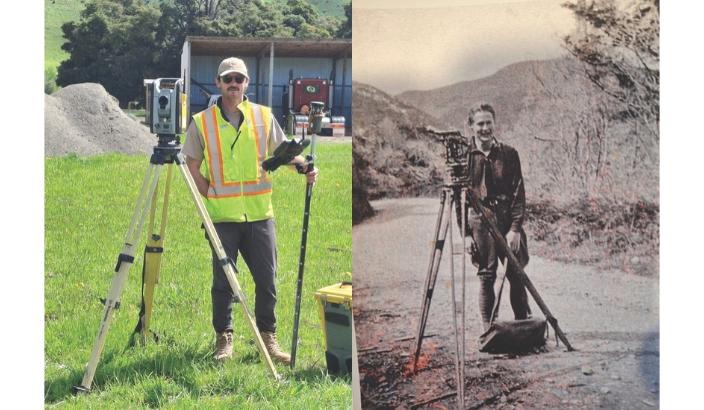
I was reminded of this adage while watching a highway surveyor peering into his tripod-mounted apparatus at Wai-iti on State Highway 6 recently.
A few months earlier, my mother had shown me a photograph of her then-teenage father surveying the Tākaka Hill on what is now State Highway 60.
Apart from subtle differences, the now socially frowned-upon smoking pipe in the historic photograph and the computerised upgrade to the equipment in the modern scene, little appears to have changed in the effort to build and smooth our vehicular paths during the past 100 years.
The comparison also reminded me of an assertion made by colourful character Lester Rountree, a long-time Motueka vintage farm machinery enthusiast who now owns and runs the Otira Stagecoach Hotel as a refreshment stop and museum.
He said: "You show me an invention which - other than computer involvement - wasn't around in some form 100 years ago."
Without becoming too pedantic, it's difficult to prove him wrong.
About 1926, budding roading engineer, surveyor and works crew foreman Jock Spence was busy upgrading the challenging Takaka Hill road before moving on to the Cobb Valley, then Golden Bay's Mangarakau and beyond, where my mother was born.
At the time, Jock was employed by the Public Works Department, which later became the Ministry of Works before being disestablished and its functions sold off in 1988.
Since then, various companies, predominantly Fulton Hogan, have been charged with the huge responsibility of maintaining New Zealand's highways.
Accordingly, a century after Jock set his sights on Marble Mountain, Fulton Hogan construction surveyor and project manager Jarrod Todd is eyeing the highway at Wai-iti, just south of Wakefield, undertaking level checks as part of pavement rehabilitation work.
Fulton Hogan was formed in Dunedin in 1933 and, by 1981, had crossed the Tasman to become a major player in Australia's roading and civil construction sector.
From 1985, the company gained more international curiosity, if not recognition, from an unlikely and unwitting promoter.
Geoffrey Hughes, better known to television viewers as Coronation Street's slobbish bin man Eddie Yeats and the similarly uncouth Onslow from Keeping Up Appearances, was invited to Dunedin as part of the nationwide charity fundraiser Telethon.
A passing Fulton Hogan truck driver tossed Geoffrey a well-worn company cap, which he later wore in episodes of Keeping Up Appearances.
Incidentally, this was not the only occasion a piece of Kiwiana appeared on iconic British television.
During the 1980s, sharp-eyed viewers may have spotted a carton of New Zealand apples in the storeroom set of Open All Hours while Arkwright and Granville pondered the meaning of life.
The registered payee number, P022, stamped on the end panel revealed the fruit came from the Nelson Packhouse Co-op in Nayland Road, Stoke.
But I digress. Now I'm comparing apertures with apples.
