
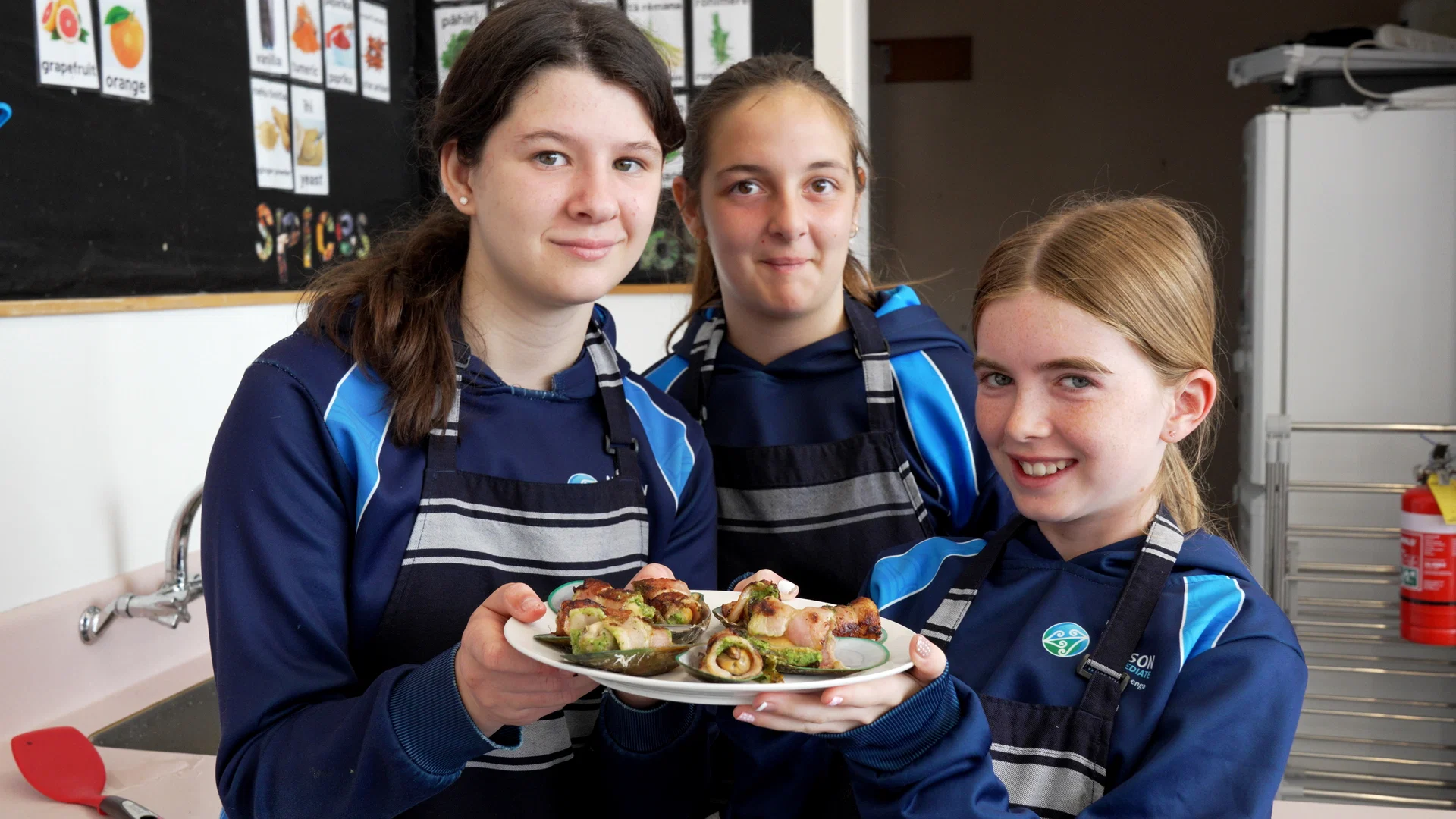
Students at Nelson Intermediate are getting hands-on with kūtai (New Zealand green-lipped mussels), learning how to prepare and cook them while helping develop educational resources that could eventually be used in schools across the country.
The classes are part of the Revitalising Māhinga Kai Project, led by the Cawthron Institute and Te Rūnanga o Arowhenua through the Ministry of Business, Innovation and Employment-funded Fish Futures Research Programme.
Cawthron freshwater ecologist Dr Katharina Doehring, the project’s lead researcher, says food is one of the most powerful ways for people to develop meaningful relationships with the natural world.
“Through preparing, cooking and tasting kūtai, students are not only learning about a species, they’re learning about the environments it depends on and our collective responsibility to care for those places.
“When young people develop a connection with a river, estuary or coastline, they are far more likely to value and protect it in the future.”
The project combines mātauranga Māori with ecological science, allowing students to explore locally grown kūtai, where they live, how they support healthy coastal ecosystems, and the cultural knowledge associated with gathering, preparing and sharing food.
The programme aims to strengthen young people’s connections to local environments and deepen their understanding of where food comes from.
“We’re interested in what our tamariki already know, what sparks their curiosity, and how learning through experience can deepen their understanding and connection to place,” Katharina says.
“If a student goes home excited to tell their whānau about kūtai, where they live and why healthy coastal habitats matter, then that learning extends far beyond the classroom.”
Nelson Intermediate Māori medium teacher Sophia Takimoana says the programme is long overdue.
“We’re in an age where food prices are rising. Sooner or later, our tamariki will need to learn to live off the land. This kaupapa is an eye-opener for them in sustainability.”
For Mātua Karl Russell (Kāti Huirapa o Arowhenua), the project is about reconnecting tamariki with knowledge and practices traditionally passed down through generations.
“There was a time when knowledge about gathering and preparing kai was simply part of growing up. Today, many of our tamariki are becoming disconnected from those traditions. If we don't create opportunities to share this knowledge, we risk losing an important part of who we are.
“Kai is part of our whakapapa. It's not just something we eat; it's a connection to our tūpuna (ancestors), our environment and the stories that shape us as people.”
The mussels used in the programme were donated by local growers MacLab and Mills Bay Mussels.
The project will continue with Arowhenua Māori School, south of Temuka, where students will explore a wider range of mahinga kai species and learning experiences.
