
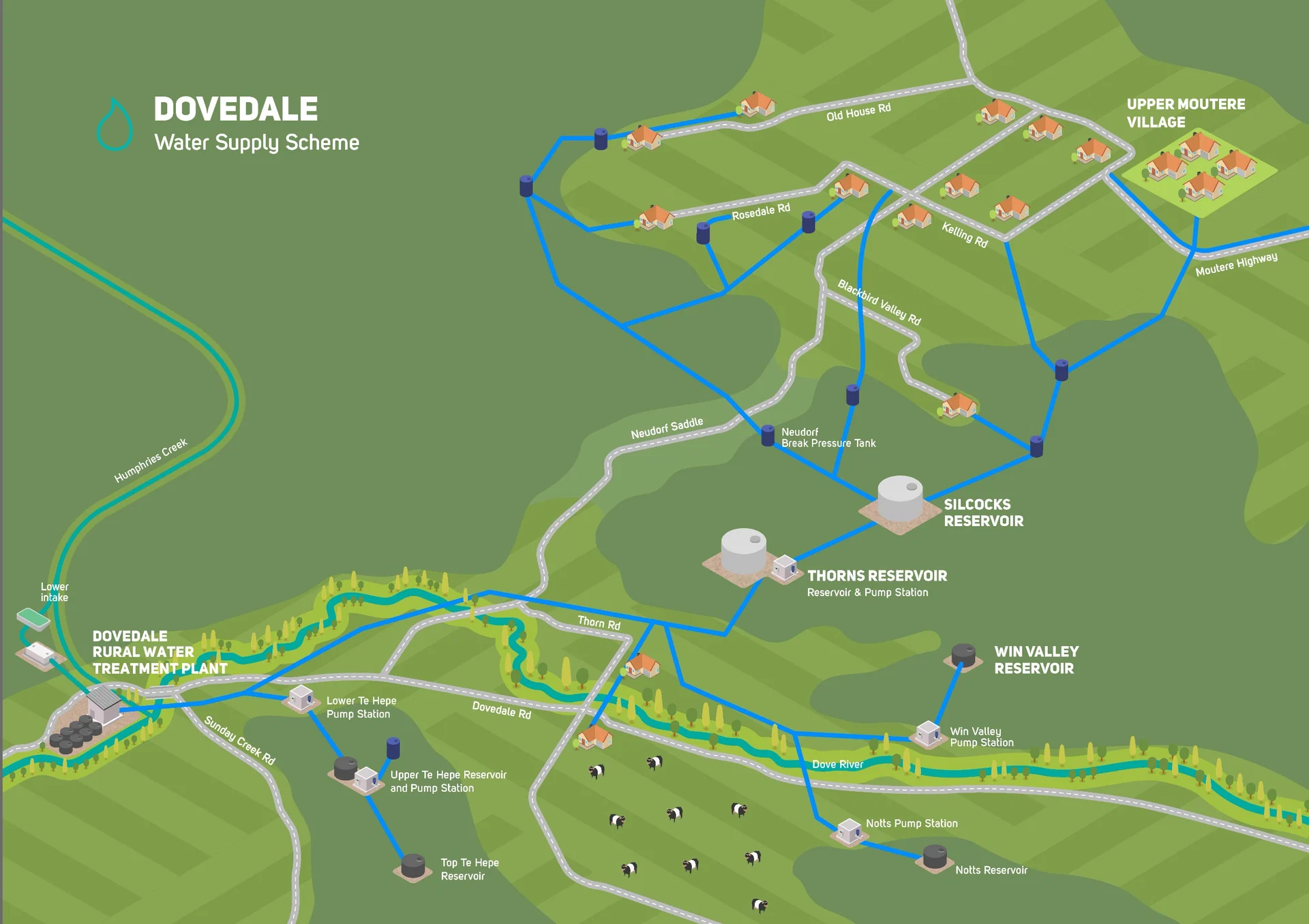
A $7.5 million upgrade to Dovedale’s water supply has been approved by Tasman District Council, despite concerns that most of the scheme’s water is used for farming rather than drinking.
The scheme supplies about 660 people through 294 connections, but about 70% of the water delivered is used for agricultural and horticultural purposes.
At a full council meeting on Thursday, councillors backed a new water source at Woodstock, a pipeline along Dovedale Rd and an upgraded centralised treatment plant as the preferred pathway to bring the scheme into compliance with drinking water standards. Only councillors Timo Neubauer and John Gully voted against the proposal.
The project is estimated to cost $7.5 million, excluding GST. The council approved additional funding of up to $5.5 million on top of the $2.065 million already allocated in the 2026/27 Annual Plan, bringing total funding to up to $7.565 million.
Operating costs are also expected to rise, with the upgraded plant forecast to cost about $107,000 a year to run compared with about $48,000 currently.
The existing supply relies on Humphries Creek, which council staff say is unreliable during summer and becomes highly turbid after even moderate rainfall.
Only one of its two intakes is operating and the treatment plant does not provide the required barrier against protozoa.
The scheme has been under a permanent boil-water notice since 1989.
Testing of two bores at Woodstock, the preferred replacement source, produced a combined yield of about 13.9 litres per second. The scheme’s peak demand is about 12 litres per second, although the sustainable yield of the bores is yet to be confirmed.
Waters and wastes manager Mike Schruer told councillors identifying a suitable replacement source had taken “considerable time” and the preferred option had already been factored into the council’s long-term planning.
But not all councillors were convinced it was the best solution.
Councillor Timo Neubauer questioned whether the investment was financially sustainable.
“This is gold-plated drinking water for stock.”
Timo believed greater self-sufficiency, including rainwater harvesting and on-site filtration, should have been considered, with the communal scheme retained for stock water and irrigation. Councillor John Gully also questioned why rainwater tanks had not been included among the options considered.
Questions were also raised about how much input scheme users had into the proposal.
Councillor Trindi Walker voted in favour of the upgrade but was concerned by the lack of public participation.
“I’m staggered there has not been a single person at the public forum,” she said.
She questioned whether people using the scheme even knew the issue was being discussed.
Strategic planning and enterprise manager Dwayne Fletcher told councillors the council remained responsible for providing safe drinking water to households.
“We can’t delegate that responsibility.”
Council staff also told the meeting that water regulator Taumata Arowai had not visited the scheme during the past year, despite being invited.
The farmer-owned scheme was established in 1979 before being transferred to the council about 1989.
While Taumata Arowai has not set a specific treatment deadline, it has asked the council to confirm its compliance pathway, funding arrangements, implementation programme and governance arrangements by 18 November.
The council’s current programme aims to have the upgrade completed by 30 June, 2028.
Councillor Jo Ellis summed up the frustration felt around the council table.
“This is such a frustrating situation as we’re stuck between a rock and a hard place.”
Local residents have a regular Dovedale residents’ meeting tonight and a specific meeting is being planned to discuss the upgrade, but no date has been set.
