
TONI EVANS
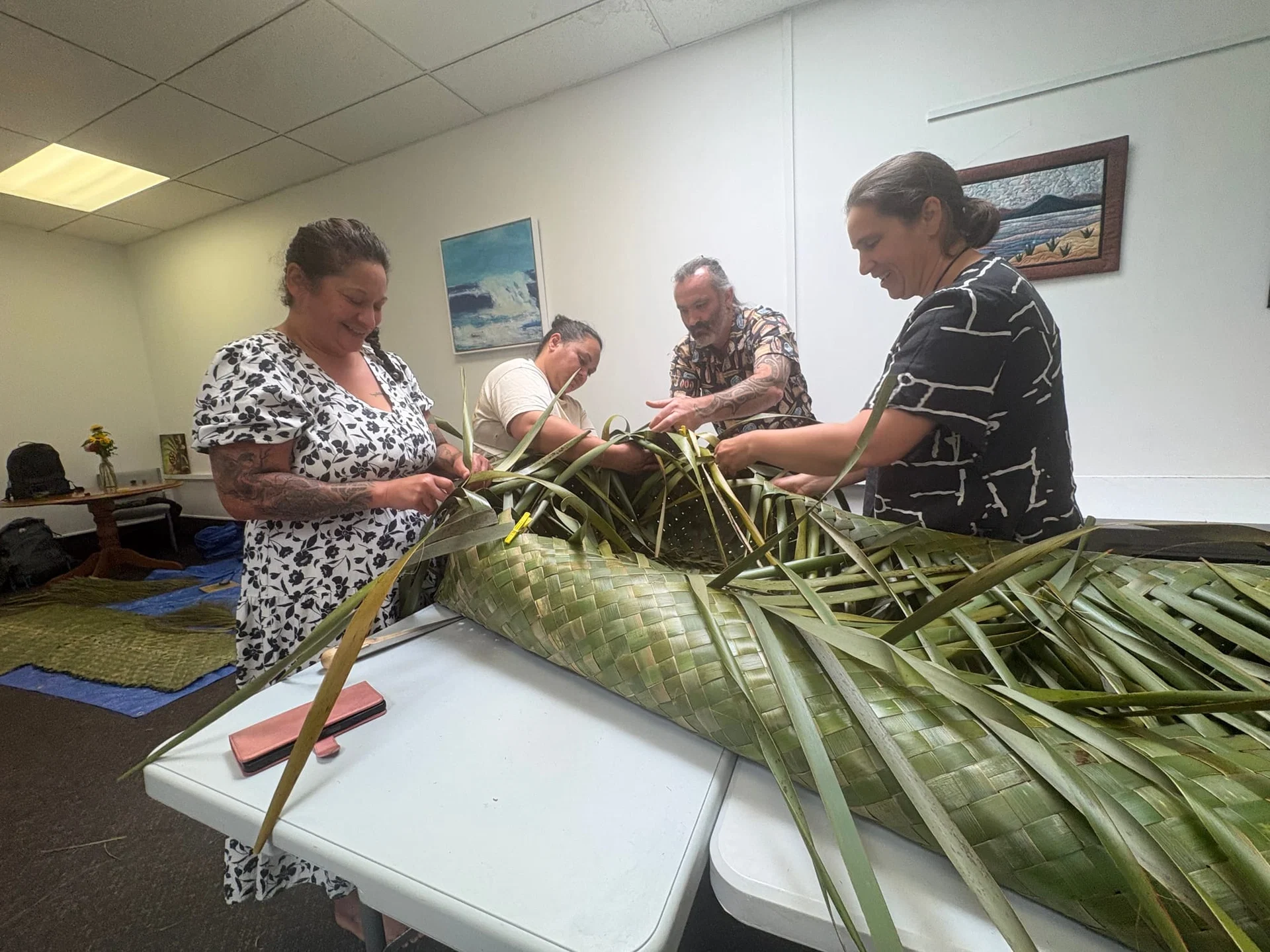
A three-day weaving workshop in Motueka has brought together people from across the top of the South Island to explore a natural, affordable and environmentally friendly approach to burial.
Organised by Maureen Urwin and Renee Pahulu, the workshop attracted about 18 people, including weaving tutor Marc Taura, to create a harakeke casket, mānuka bearer and ropes for lowering the casket into the ground.
The first workshop of its kind in the region drew participants from the West Coast, Golden Bay and Marlborough.
Maureen, who is training to become a death doula, and Renee, a local weaver, learned Marc was available to travel north to teach the technique. Together they organised the workshop, bringing together experienced and inexperienced weavers, people involved in the funeral industry and others interested in natural burial.
The finished casket will be kept as a template, with the intention of gifting the next one made to someone who needs it.
Lynda Hannah, an end-of-life doula, death educator, natural funeral facilitator and author, was among those taking part.
A long-time advocate for natural burial, Lynda welcomed the establishment of Motueka Natural Burial Park, which opened in 2010.
She says traditional cemeteries require considerable resources, including concrete, mowing and weed control, while treated timber and MDF coffins, along with embalming chemicals, can have negative environmental impacts.
Natural burial offers an alternative using biodegradable materials and avoiding embalming. Lynda says there is a widespread misconception that embalming is compulsory, and much of her work involves educating people about preparing for death and caring for a body without embalming.
Lynda says she was delighted to take part in the workshop and grateful to Maureen and Renee for creating the opportunity.
Participant Jo Johnson had little previous weaving experience.
“I’m not an experienced weaver and it’s been really fine for us,” she said. “There are experienced weavers here and everyone has been really generous sharing their knowledge and help.”
Jo supports do-it-yourself burial options and says watching the casket emerge from a flat geometric shape into its finished form had been amazing.
For Marc, the workshop was a chance to share a technique many experienced weavers had never attempted.
A Unitec graduate and the first weaver in his family, Marc previously worked in tourism before Covid-19. He later received funding to teach weaving in Central Otago, although that opportunity ended following a change of government.
Now travelling around the country teaching, he hopes to move to Northland and develop weaving education into a full-time career.
Marc also spoke about the history of male weavers in Māori culture. Before colonisation, men undertook many weaving roles, including work inside wharenui during construction, where women were not permitted until completion.
He believes colonial attitudes towards gender contributed to weaving becoming associated predominantly with wāhine.
Among the weavers he admires is Nelson weaver Hamuera Manihera, who alongside Naomi Aporo-Manihera led Taku Rau Tīkumu, an exhibition exploring the revival of traditional weaving using tīkumu, a native alpine mountain daisy.
Marc says he is particularly inspired by Hamuera’s work reviving ancient and often forgotten weaving techniques. By studying historic woven taonga, including those held in international museums, Hamuera is able to recreate techniques that might otherwise be lost and share that knowledge with new generations of weavers.
The workshop follows a recent Death Without Debt event and is one of several opportunities offered locally during Dying Matters Week, encouraging conversations about death and dying before families are faced with difficult decisions while exploring affordable, natural alternatives to conventional funerals.
The Cancer Society Nelson Tasman values community, connection and creating spaces where people can come together. It was the organisation’s privilege to host the weaving workshop at its Motueka office.
Marc has confirmed he will return to run another workshop on 22–24 January 2027, with limited spaces available. Those interested can contact Maureen at the Motueka Cancer Society to register their interest.
