The Royal New Zealand Returned and Services Association (RSA) was formed in 1916 to support service men and women and their families.
In Nelson, the movement began in late June that year when about 20 returned soldiers met at the Institute to discuss forming a local branch.
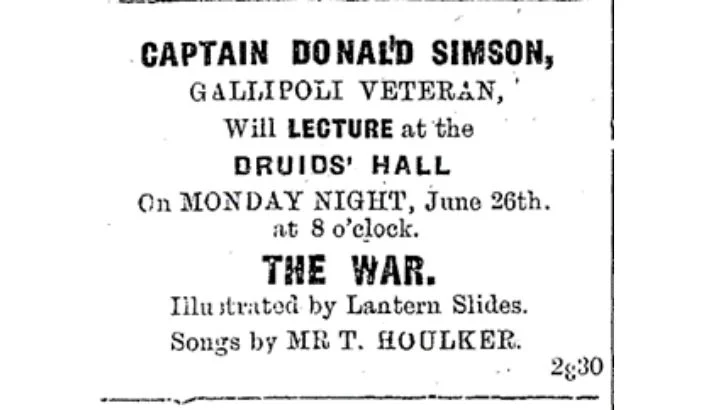
Captain Donald Simson, who served at Gallipoli with the New Zealand Engineers (British Section), addressed the meeting and was later credited as the driving force behind the initiative.
Donald outlined the association’s aims, stressing that returning soldiers were entitled to the best care the country could provide.
He recognised the challenges servicemen and women faced when transitioning back to civilian life and warned of the risks if mental and physical issues were left unaddressed.
Donald believed a Nelson branch would help future recruitment, reduce grievances, and provide a channel for discussions with defence authorities.
He encouraged Nelson residents to join the movement and establish a returned soldiers’ club with an information bureau.
A five-month study of returned servicemen concluded that only through a properly organised club could their welfare be managed.
Private Beagley read aloud the draft constitution adopted at a Wellington conference.
T. Field, Member of Parliament, predicted the association would become a powerful body that no Government could ignore.
Until then, local patriotic committees had carried much of the responsibility for supporting soldiers, both returned and serving.
At a Dominion Advisory Board meeting, a resolution was passed in favour of a moratorium to protect soldiers’ property.
Wallace Snodgrass illustrated the need for this by citing a Nelson case where a wife was pressed for interest on her home while her husband was at the front, despite paying previous arrears.
Patriotic committees had achieved some reforms, but an Association carried more weight.
The meeting concluded with Beagley moving that a branch be formed in Nelson, seconded by Trooper Riches.
The motion was carried unanimously, and a seven-member committee was appointed: Sergeant Dement as chairman, Beagley as secretary, Sergeant Liddle, Privates Giblin, Bird and Burts, and Trooper Riches.
They would act until the next Wellington conference. The following day, Simson delivered a lantern lecture featuring photos of Egypt and Gallipoli, with proceeds going to the newly-formed Nelson branch.
Got a history story you’d like told? Email rjparkes@xtra.co.nz
