
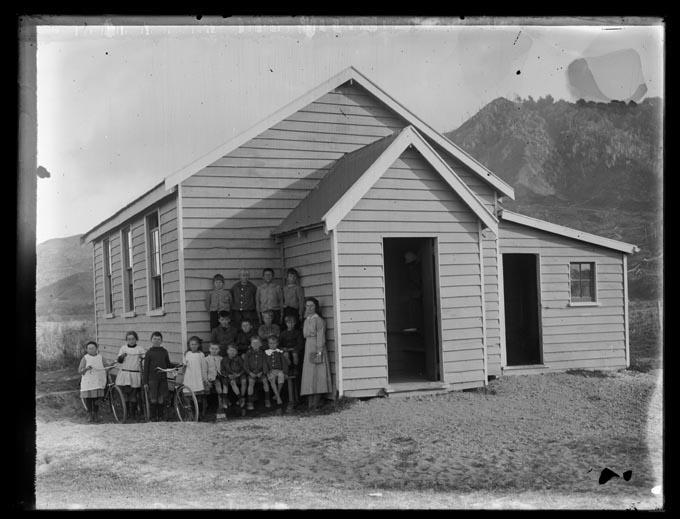
A section of land in Pākawau was reserved for a school in 1864 and allocated to the Nelson Central Board of Education. By 1873 local residents had cleared the bush and built a schoolhouse.
Funding was secured to employ a schoolmaster and the school opened with 10 students.
In 1874 the roll fell and the school closed for four years. The Education Act 1877, which ensured free and compulsory education, forced the Board of Education to reconsider its decision. The Inspector was instructed to assess how many local children might attend. In July 1878 the board agreed to subsidise the school and advertised for a mistress on a salary of £72 per year. The roll soon rose to 21 children.
In 1880 Miss Sheppard was appointed school mistress, a role she held for two years before Mr Porteous took over in April 1882. The next teacher, Mr J McIntosh, arrived in August 1883 and quickly became a popular figure in the community.
By 1885 a new school building had been constructed and the original schoolhouse converted into a teacher’s residence.
Annual examinations and assessments were part of school life. In 1884, the Inspector praised McIntosh for the strong results achieved by students, noting that children walking three or four miles over rough roads still arrived for examination day. He commented that it was the shame of scores of laggards, especially in some of the towns who could not even travel half a mile.
Fundraising played a significant role in supporting the school. In late 1889 the committee organised a tea party for a small fee and was overwhelmed when about 170 people attended. Seventy came from Collingwood, with others travelling from Ferntown. Refreshments, including strawberries from Mr Davidson’s gardens, were appreciated. With the schoolroom far too small, tables were set up outside. After nightfall, the room was cleared for dancing. The Inspectors report of 1890 was less favourable. Of the 33 children on the roll, many fell short of expectations. Reading was intelligible, but spelling remained beyond the reach of several students.
By 1892 Miss Sadd had taken charge and was soon recognised as an effective and capable teacher. Glowing reports followed in 1892 and 1893.
Teachers continued to arrive and depart, often staying only a year or two. In 1897 Miss Beuke was school mistress and was also appointed telephonist and postmistress after a telephonic room was added to the school.
In 1914 the Nelson Education Board informed the School Committee that the school would be moved to another site. The roll fluctuated over the following decades and closure was again threatened in 1943. One proposal to boost numbers involved transporting children from Puponga, although this proved difficult. Redevelopment of the school buildings was completed in 1953 and continued until 1981 when the school closed.
