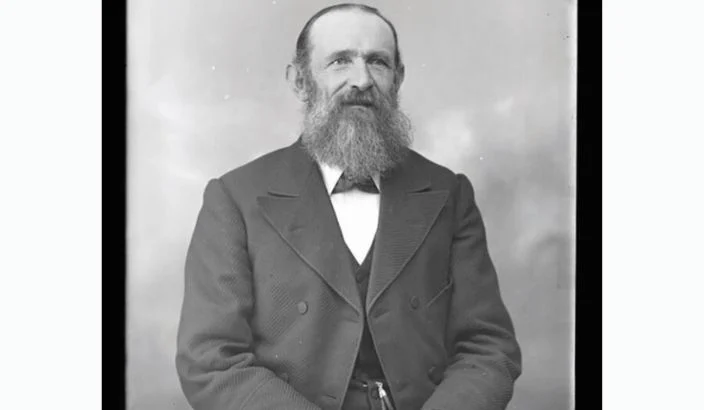
Henry Budden, the son of George and Sarah Budden, was born in 1842 in Thorncombe, a village in northwest Dorset bordering Somerset and Devon. In the 1860s the family immigrated to New Zealand and settled in Wellington.
From a young age Henry showed an interest in horticulture, and in 1866 or 1867, at 24, he won second prize at the Christchurch Horticultural Show as the second most successful exhibitor. After spending some time in Canterbury he returned to Wellington and established a business named Wellington Nursery and Seed.
Failing health contributed to his decision to move to Nelson around 1878. Soon after arriving he opened a shop on Bridge Street and developed a large piece of land into an extensive flower garden featuring 180 varieties of roses. He also set up a seed farm in New Street to grow vegetables and began producing an annual gardening calendar.
Henry rented land at Riwaka to grow bulbs, placing Mr Cook as overseer.
In 1886 his business took a severe downturn. He lost £300 worth of stock after saltwater seeped into his garden during sewer construction, another £100 of stock was destroyed in a flood at Riwaka, and trade had slowed. Unable to continue, Henry filed for bankruptcy in February 1887.
Despite hardship he continued to create. In 1889 he illustrated and published a leather-bound catalogue of bulbous flowers grown at Riwaka, hand painting many of the blooms.
The following year he moved to Riwaka permanently, running a nursery near the Motueka bridge for several years. His horticultural expertise was widely recognised and he was often sought after as a judge at local shows.
Henry later purchased a former accommodation house known as Britannia and converted it into a home he named Tuba Flora. The surrounding grounds were developed for growing bulbs, flowers and vegetables. Potatoes were a particular focus and were grown under a strict regime to ensure high quality seed. Long bins, subdivided into compartments, kept each variety separate. Grading was carried out by Henry or under his close supervision.
Old varieties such as Vermont, Beauty of Hebron, Charles Downing, Fiddlers Victory, Minister, Magnum Bonum and Snowdrop were among those grown. The crops were dug, gathered and taken to the yards for grading. Tubers that were too large or misshapen were used as animal fodder, those suited for cooking were placed in sale bins, and the highest quality tubers were stored for future crops.
In February 1899 Henry raised concerns with the council about the Motueka River threatening the Riwaka bank near the cart bridge and urged urgent protection work. A month later two days of rain caused the river to break its banks, flooding surrounding land including Henry’s bulb garden, which was submerged under several feet of water.
Alongside running his nursery, Henry was involved in establishing the Jam and Fruit Preserving Company in Nelson, regularly exhibited at shows, served as secretary of the Motueka Orchestral Society, was a member of the Motueka Horticultural Society and performed in musical events.
Henry died on 8 September 1902, having lived a full and industrious life.
