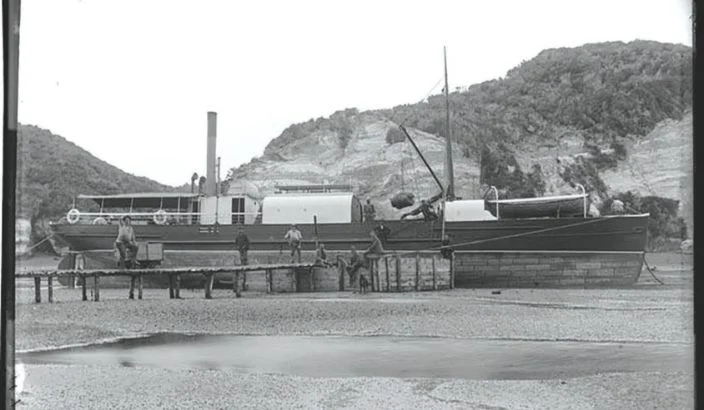
The little steamer Lady Barkly was fondly remembered by the people of Nelson and, in particular, the settlers of Golden Bay as she plied the bays delivering goods and transferring passengers.
Built in Australia in 1861 from gum hardwood as a paddle steamer for Sir Henry Barkly, Governor of Victoria, she was named in honour of his wife. In 1863 the New Zealand Government purchased the vessel to transport provisions and munitions between Onehunga and Drury during the Māori Wars. Once that period ended, she was no longer required and was left neglected on the mudflats of Manukau Harbour.
In December 1866 it was advertised that J Cross had purchased the Lady Barkly with the intention of running her between Nelson, Motueka and Collingwood. With her light draught, she was well suited to the shallow waters of Golden Bay.
The timber-built, coppered and copper-fastened steamer measured 90 feet from stem to stern with an 11foot beam. She was fitted with a low pressure sidelever engine of 22 horsepower and could steam on 15lb pressure, travelling ten knots per hour for 24 hours consecutively. Once in Nelson, a new boiler was fitted and further repairs were undertaken.built, coppered and copperfastened steamer measured 90 feet from stem to stern with an 11foot beam. She was fitted with a lowpressure sidelever engine of 22 horsepower and could steam on 15lb pressure, travelling ten knots per hour for 24 hours consecutively. Once in Nelson, a new boiler was fitted and further repairs were undertaken.
Captain John Walker was appointed as master, and in June 1867 the Lady Barkly undertook her first journey to Collingwood, calling at Motueka and Waitapu. On her maiden voyage from Nelson to Motueka she carried members of the Nathan Troupe entertainers.
The following month she landed passengers at Motueka before heading to Astrolabe to deliver provisions to the stone quarry party at Adele Island, arriving at Collingwood that evening. Heavy wind and sea conditions were experienced during the trip, but the Lady Barkly proved herself seaworthy and reliable. Masters claimed she knew the tricky turns of the winding channels leading to Takaka and Collingwood so well that she could negotiate them almost on her own. Around the 1880s she was converted from a paddle steamer to a screw steamer.
One amusing story linked to the Lady Barkly was recorded by onlookers. A passenger travelling to Motueka brought aboard a large boar pig. When the captain asked for freight fees, the passenger refused, insisting the pig was his luggage.
The captain said nothing further, but on arrival the pig remained onboard. When the passenger complained, the captain replied that luggage was what a person carried ashore, and he was welcome to do so as they were about to depart. The man immediately paid the freight, and the pig was landed on the wharf, much to the amusement of those watching.
Over the years the Lady Barkly proved thoroughly reliable as she carried passengers and goods across the region. She was chartered for pleasure excursions, transported patients needing medical help, assisted in rescuing shipwrecked passengers and supported searches for lost boats.
After several changes of ownership, she was renamed Hina around 1915. At the end of 1921 she ceased trading through the areas she had long served and was sold by auction in Nelson. She later lay on the mudflats near the old Gasworks Wharf and, in 1934, was towed to Haulashore Island where she was broken up.
