Nelson’s much-loved A and P Show at Richmond Park was once an annual highlight for farmers, tradespeople, competitors and spectators. But with the outbreak of World War Two the showgrounds were requisitioned for war purposes, bringing the event to an abrupt halt.
The normal two-day show went ahead in 1941, but in 1942 the Army authorities informed the A and P Association that the grounds would be required for the duration of the war. The Association could no longer operate as usual and the annual show was cancelled.
A smaller wartime executive committee was formed to manage maintenance, oversee the grounds and plantations, negotiate with the Army Department and work with grazing tenants. It then had to consider what activities could continue without access to Richmond Park.
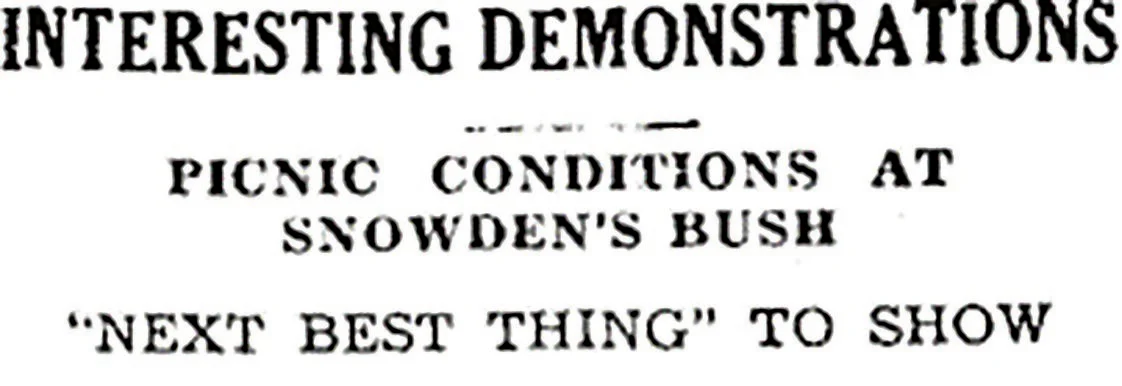
A creative solution soon emerged. The Nelson Jersey Breeders Club, which held its own annual stock day, approached the Association about joining forces. Together they organised a stock field day, held in November at Snowden’s Bush.
The setting was beautiful, but with transport limited there was uncertainty about how many people or animals would make it in. Around 500 people attended, enjoying a picnic-style day in the scenic surrounds.
With no trucks available, stock arrived on foot, behind cars, or squeezed inside them. One of the more humorous sights was a young lass nursing her pet lamb in a car, followed closely by another vehicle where children knelt on the back seat to make room for a large Dorset horned ram.
The day featured demonstrations on various breeds of sheep, cattle and horses. Competitive classes were limited to ponies and children’s pet lambs and calves, while sheep dog trial displays and music from the Wakefield Band entertained visitors.
There was hope the war would end before November the following year so the show could return to the Park, but this did not eventuate. Another one-day field day was held at Snowden’s instead. Even in 1944, the Army retained control of Richmond Park.
Army authorities told the A and P Association that they could not return to the grounds until the huts had been disposed of, a process expected to take some time. They did, however, allow a gymkhana-style event. Although not ideal, the Association agreed to it in order to maintain public interest in its work.
The show returned to the Park in 1944 for a one-day event, marking its 50th annual show. Appropriately, it was called The Victory Show.
Heavy morning rain affected attendance early on, but the weather improved in the afternoon. The crowd reached the second-highest attendance in the show’s history, with about 8000 people entering the grounds. It highlighted how much the event had been missed, and reinforced its place in the community.
