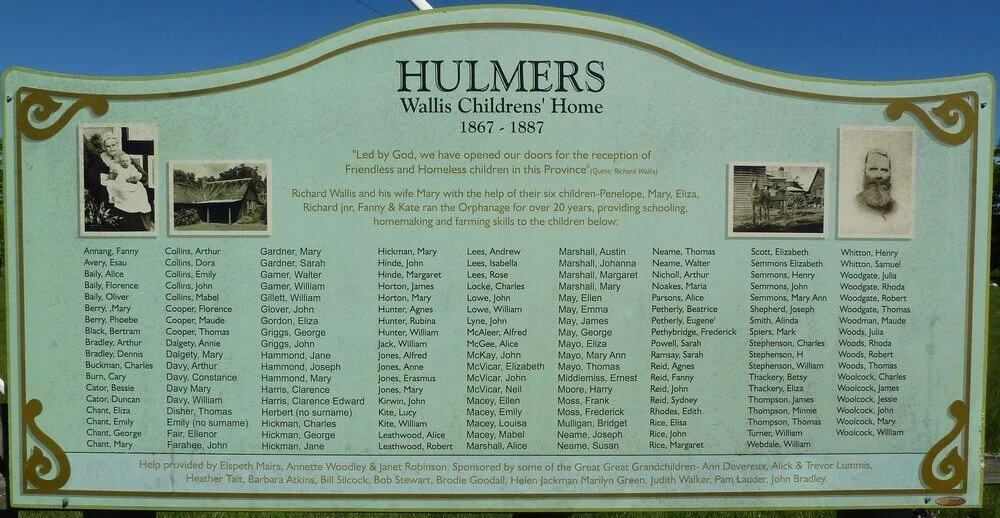
Richard Wallis was born in 1819 to Richard and Mary and emigrated to New Zealand in 1842 on the London, disembarking in Wellington before sailing to Nelson on the Blossom. For a time he lived in Waimea East, where he undertook a range of roles including Wesleyan preacher, registrar, magistrate's clerk, teacher, postmaster and carter.
Richard’s future wife Mary Ann arrived in Nelson the same year on the George Fyfe with her new husband John Coster. The couple settled in the Waimea area and their first child was born in March 1843. They later returned to Nelson, where John became a constable and joined the party sent to Wairau in June 1843. He was killed in the affray, leaving Mary alone with her baby.
The following year she married Richard. In 1866 the couple moved to the Motueka district, obtaining land in Hursthouse St, naming the property Hulmers.
In 1867 they opened their home as a refuge for ‘fallen’ women, but after several months the trial initiative proved unsuccessful.
During this work Richard and Mary became concerned about the number of children growing up in difficult circumstances, with some already showing signs they might drift into crime. Many mothers agreed to place their children in the couple’s care.
The pair also widened their efforts to include rescuing children from the streets. Their focus was particularly on street girls, who they believed needed more than ordinary care to protect them from the dangers surrounding them.
By March 1869 there were 14 children living in the home, along with the Wallis children. The Nelson Provincial Government asked Richard whether they would take another 12 children who were then scattered in homes around Nelson. The couple agreed, with the government paying one shilling a day for each child’s lodging, food, clothing and education until the age of 14.
Richard recommended that the government set aside about 50 acres of land for a farm to help make the home partially self-supporting and offer outdoor work for the boys. This was not supported, so Richard rented land instead. The farm provided the home with ample milk, butter and sheep for meat, and room for cows, horses and bullocks.
In 1870, needing more space, Richard leased Burrell’s empty house, The Gables, in Motueka. The home operated from there until around 1878, when financial difficulties forced the family back to Hulmers.
From the age of six, each child was educated on the premises in reading, writing and arithmetic, four days a week from 9am to 4pm. Mondays were dedicated to washing, a task that likely took all day with so many children. Life at the home was busy.
