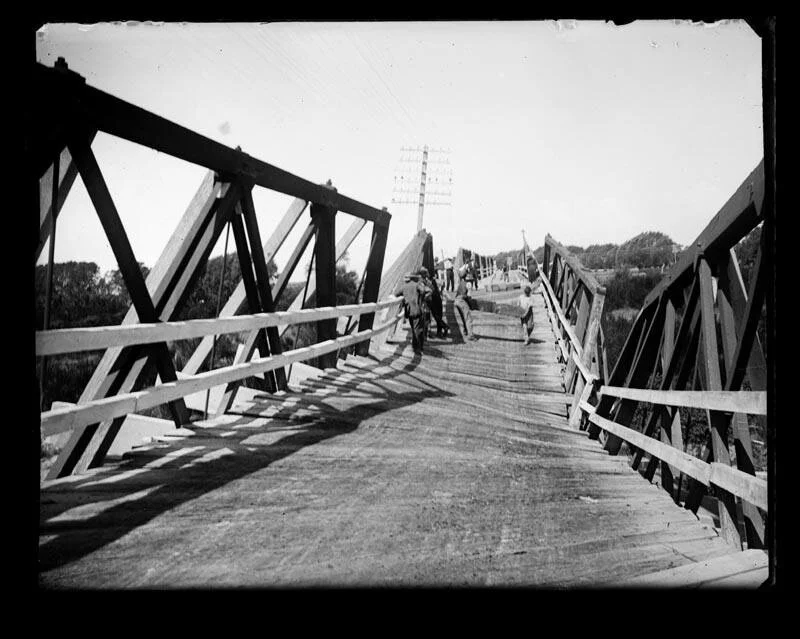
For decades, crossing the river between Motueka and Riwaka was a dangerous and uncertain task, with lives often at risk.
From 1847, the only dependable way across was by ferry, after the Nelson Provincial Council granted an accommodation licence on the condition the holder also act as ferryman. Edward McNabb was the first to take up the role, followed by Adolph Dodson, who ran the service for many years until a bridge was eventually built.
Those needing to cross rang bells placed on either side of the river to summon the ferryman. During floods, when the river was too dangerous, Adolph raised a large black ball on a pole outside his house to warn that no crossings could be made.
Despite these precautions, some people still attempted to ford the river on foot or horseback, often with fatal consequences.
By the late 1870s, the growing settlement at Riwaka increased pressure for a permanent bridge. Progressive settlers argued a safer, more reliable crossing was essential, particularly for getting produce to market. Others opposed the idea, and the proposal remained contentious.
In 1876, an application was made to the Government for funding to build a traffic bridge. Plans were drawn up in early 1877 and tenders invited. The original design specified totara piles, but severe flooding later that year raised the riverbed significantly. The plans were revised, with kauri piles specified instead.
The construction contract was awarded to Mr Britton of Auckland, who brought an experienced team of bridge builders with him. Completed in 1878, the bridge cost £6000, with a further £2000 spent on its approaches.
Ongoing local disagreement meant the bridge opened without a formal ceremony.
Over time, the structure began to fail. In 1917, the Riwaka end collapsed and was rebuilt between June 1917 and 1918 at a cost of £2550. The Motueka end followed, reconstructed between 1918 and 1921 for £4000.
Left in place was the ageing central section of the original wooden bridge, increasingly regarded as unsafe for heavy traffic.
In February 1921, part of this older section gave way when supporting piles collapsed, causing the bridge to drop. Temporary repairs were made by jacking the structure back into position, but it was clear the fix would not last.
Public concern continued to grow, but major work was delayed. The inevitable occurred in September 1925, when flooding caused a section of the old bridge to subside by about 18 inches.
The bridge was first closed to vehicles, then shortly afterwards to pedestrians when the damaged portion began to hang precariously. A temporary deviation bridge was quickly constructed, with eleven piles driven by crews working in two 12-hour shifts. This emergency structure cost £994.
By early 1927, the temporary bridge was still in use, with safety concerns increasing as traffic volumes grew. The Farmers’ Union pressed the Government to act, urging construction of a permanent replacement. In response, the Minister of Public Works declared the highway section, including the bridge, a Government Road.
Further damage from heavy rain in April 1928 rendered the temporary bridge unusable once more, reinforcing the urgency of the situation. Construction of a new bridge was already underway, and by December all pile driving had been completed. Officials expected the bridge to open the following March.
On 23 May 1929, a new ferro-concrete bridge was officially opened. Stretching 1075 feet across 25 spans, it marked a major improvement in safety and reliability.
The ceremony was led by the Prime Minister, with the ribbon cut by Mrs O. Wilkinson. In a symbolic first crossing, Alexander Drummond drove his horse and sulky across the bridge, accompanied by the Nelson Pipe Band.
That bridge served the community for 23 years, before being replaced in 1957 by the structure that stands today.
