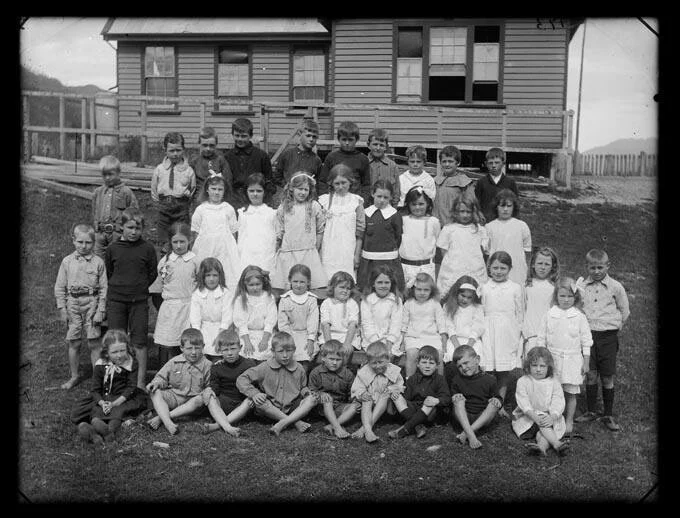
The beginnings of schooling in Hampden, now Murchison, can be traced back to November 1882, when George Moonlight offered the use of a building for a school.
Mr Quirk agreed to act as teacher on the condition that a residence was built for him, a proposal the Nelson Education Board supported, agreeing that a house be erected on the reserve.
Until then, children from Hampden attended Fern Flat School, a journey that required crossing two rivers and was often impractical. The solution was to draw an invisible boundary on the ground, allowing Hampden to establish its own school. Quirk was appointed master until an inspector could visit the district.
In August 1883, the Hampden Aided School committee advertised for a teacher to take charge of the school, offering a salary of £75 per annum. An aided school was a small, community-established school in a remote area, partially supported by the Education Board to provide essential materials and contribute towards a teacher’s salary. It was not until October that Miss Clissold arrived to take over the role.
Requests were later made to the Education Board for funding for a purpose-built schoolroom in a more central part of the district, but these appear to have been unsuccessful.
By early 1885, the school had a roll of 28 pupils under the tutelage of Herman Huddleston. Another attempt to secure a new school building was made in November that year, and this time the Board agreed to cover half the cost. However, there was still no progress, with the school inspector suggesting the community’s courthouse was suitable for teaching. A final decision was deferred.
In February 1886, the Board returned with a compromise, agreeing to provide £4 per year to cover rent for a building owned by Mr Rait for school purposes. It was not until August 1890 that Murchison was officially recognised as a school district.
A further request for funding to build a new school was lodged in late 1892. Although the Board agreed to look into the proposal, it took another two years before its architect was authorised to draw up plans. Finally, in May 1894, the tender of Alexander Sutherland, at £240 19 shillings and three pence, was accepted for the erection of a new school building.
Huddleston resigned in October 1904 after 20 years at the school and was farewelled with a social. He was succeeded by George Lawn later that month. Lawn was joined in January 1905 by Mrs C Webb, who was appointed assistant mistress.
As the roll increased and attendance became more regular, the school committee applied to have the building enlarged. Lawn taught at the school for five years before resigning in late 1909. Hugh Horner took over later that year and resigned in May 1912.
With no permanent teachers in place, one teacher from Nelson and another from Reefton were seconded to cover classes until appointments could be made. In June 1912, Mr M Rogers, from Motupiko School, was appointed headmaster.
Soon after the arrival of the new staff, the school committee wrote to the Education Board requesting the purchase of a strip of adjoining land from Mr T Bell. The land was intended to allow for the enlargement of the school, additions to the teacher’s residence and improvements to the school grounds.
While it is unclear whether the land purchase went ahead, the Board approved the school’s enlargement and granted funding to accommodate an additional 30 pupils.
