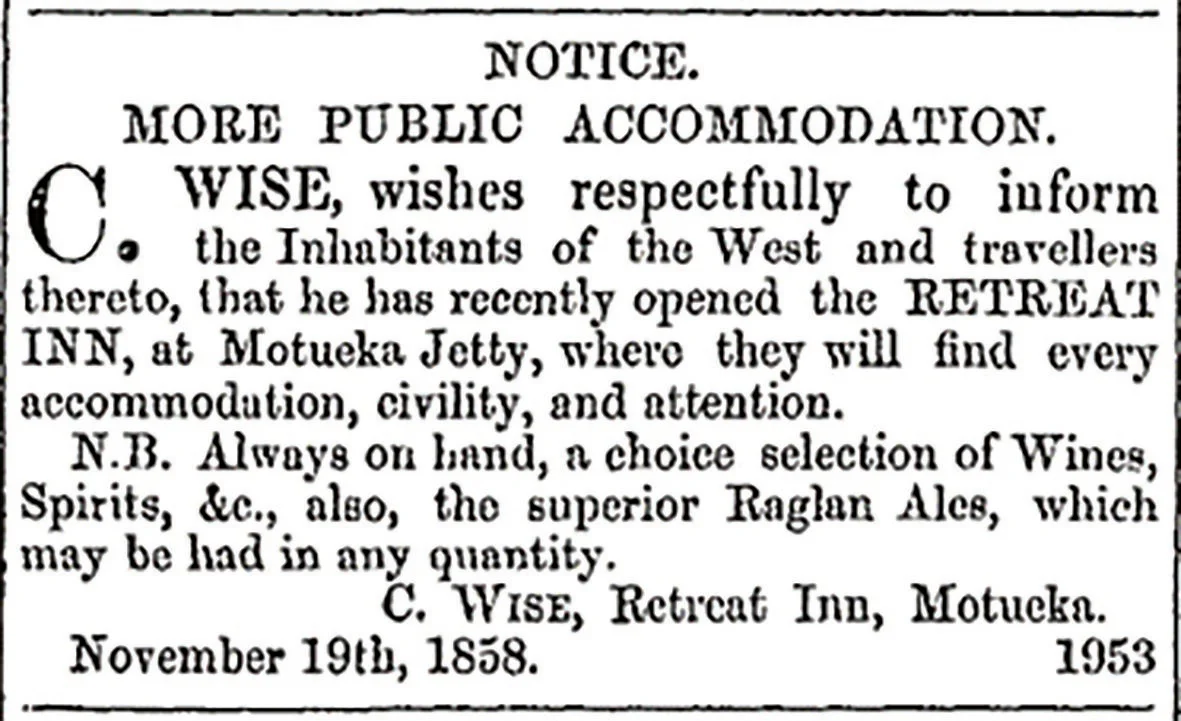
A hotel built beside the Motueka Jetty in late 1858 quickly became one of the district’s busiest and most troubled stopping points.
Known as the Retreat Inn, the hotel was established to serve travellers arriving by boat and steamer. Its first publican, Charles Wise, soon recognised the advantage of the location and set about expanding the services offered. Alongside the Inn, he ran a light conveyance service between the jetty and the town, helping passengers and freight complete the journey inland.
By mid-1860, Charles had also built a storehouse where goods arriving or departing by sea could be stored at moderate rates. The combination of accommodation, transport and storage made the Retreat Inn a hub of activity.
The Inn gained a reputation as a lively stopping place. Travellers appreciated the food and drink, although some occasionally took that enjoyment too far. In July 1860, six men left the Inn and caused widespread mischief, later claiming it was meant as a joke. Gates, ladders and farm fittings were shifted between properties, horses were released into paddocks and haystacks were damaged.
The men, W. Little, M.D., F. Ball, Ensign Franklyn, A. Gascoyne, W. Jones and C. McCabe, were arrested and sentenced to two weeks in Nelson Gaol.
During their years at the Retreat Inn, Charles and his wife Mary raised seven children, although they lost two sons at a young age. Despite the personal toll, the business continued to operate. One of its better-known traditions in the 1870s was the annual visit of the Nelson Naval Brigade. After disembarking at the jetty, the men were served breakfast by Mary.
In July 1875, Charles died suddenly aged 59, leaving Mary to run the Inn alone while caring for their five remaining children, the youngest just nine. She continued managing the business, but conditions became increasingly difficult.
Late in 1877, an intoxicated man, William Muruane, violently assaulted Mary and her daughter. They were forced outside while he locked himself inside the building. He was later charged and ordered to keep the peace for six months, with a surety of £100.
Mary’s position worsened in March 1878 when property owner Thomas Harley sought her eviction following a dispute over lease terms and the quality and price of beer supplied. The court ruled in Harley’s favour, and despite an appeal, Mary was forced to give up the Inn.
The licence was transferred to Joseph Auty, but his tenure was short-lived. By November, the property was again advertised for lease and Henry Talbot took over. Talbot later requested payment for maintaining a lamp to guide vessels entering and leaving the port, threatening to remove it if he was not compensated. He was awarded £10 and remained at the Inn until about 1881.
Little is recorded about the property over the next decade, and the name Retreat Inn gradually fell out of use. In 1891, an application was made to relicense the premises, described as ‘the hotel previously known as the Retreat Inn’. Local residents strongly opposed the move, arguing the district had no need for another licensed house.
In May 1892, William McCabe applied for a publican’s licence under a new name, the Wharf Hotel. Once again, opposition was strong, with a petition signed by 239 residents stating the earlier failure of the business proved it was neither needed nor viable. Thomas, however, argued that travellers waiting for steamers required refreshments, and the licence was granted.
The renamed hotel struggled to survive. Within a year, William was declared bankrupt. He attempted to temporarily transfer the licence to Edmund Greenslade, but authorities refused, insisting he either continue operating the business or forfeit the licence altogether.
Edmund took over regardless, but his circumstances were bleak from the outset. Already in debt and in poor health, he had little capital, paid £1 per week in rent and attracted few lodgers. With many locals boycotting the hotel, beer sales were minimal and the business could not be sustained.
The goodwill of the hotel was eventually offered for sale. Although it continued for several more years, the building ultimately ceased operating as a hotel and was later converted into a boarding house, bringing an end to Motueka’s short-lived jetty-side inn.
