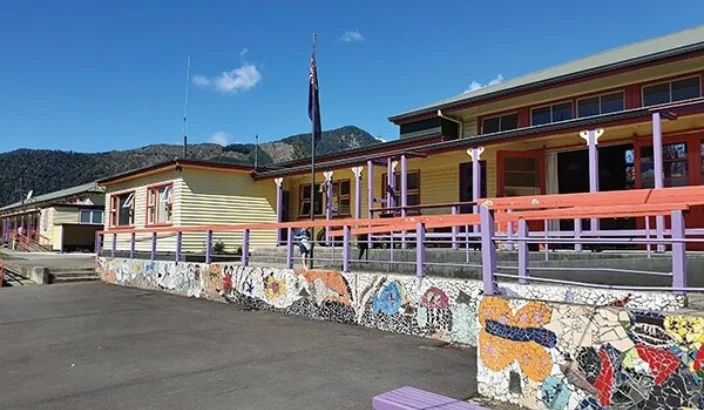
A visit from a battleship and decades of determination marked the long journey to a new Murchison school.
An exciting event for Murchison children took place in 1913 when HMS New Zealand berthed in Nelson. Arrangements were made to transport pupils by truck and train so they could view the ship. The following day they returned home in a covered truck, travelling in cold weather and strong winds. For some, it was their first glimpse of the sea and their first train journey.
In February 1914 the Education Board postponed plans to enlarge the school. Around 1916, Rogers resigned and was replaced by Miss P. Bolton, who remained in Murchison for five years before Stuart Morris became headmaster.
The issue of a new school refused to go away. Despite the school committee pointing out that the building was about 25 years old and insanitary, the Board’s response was a firm no. Residents agreed the school was inadequate and the site unsuitable, prompting another request for a larger school on the education reserve at the eastern end of the township.
Board members visited the site but later suggested approaching the Education Department to secure the municipal reserve opposite the Council Chambers, on the condition householders prepared the land and filled in the creek after it was piped.
School life continued regardless. In November 1923 a War Memorial Roll of Honour bearing 36 names was unveiled. The memorial was funded entirely by pupils, who raised the money through a fancy-dress ball.
Disaster struck in May 1925 when fire destroyed the library building, which was being used as an extra classroom. A temporary classroom was created from the shelter shed. The following month the Board approved a grant, not for a new school, but to improve the existing one with flat ceilings, an additional room, a corridor and a headmaster’s room.
The remodelled school was officially opened by Hon W. H. McIntyre in November 1925. In early 1928 approval was given for a Seventh Standard at Murchison School, which opened in April 1929, officiated by MP G. Black.
That same year Stuart resigned to take up a position at Stoke School. He was replaced by F. S. Hayes, who remained only briefly before A. Thorn took over. Thorn resigned in late 1933 and Robert Moir became headmaster.
By 1937 the school roll had grown to 95 primary pupils and 22 secondary students. A new secondary classroom was added, but the school committee was unimpressed, saying it was architecturally outdated, blocked the views of nearby bungalows, detracted from the surrounding landscape and sat too close to the road.
Two years later, with pressure continuing to mount, an urgent request for a new school was again declined. Instead, the committee was forced to rent the Oddfellows’ Hall in February 1940 to house the secondary department.
Finally, in April 1944, the Board approved plans for a new District High School comprising five classrooms, three primary and two secondary, along with a manual training centre. At the time, the roll stood at 145 students, made up of 114 primary and 31 secondary. A. R. Easterbrook was headmaster.
By October the plans had been finalised and tenders called. L. C. Robertson won the contract to erect a four-room block, a single classroom and prepare an additional section of land. The manual training room was remodelled from an existing building.
A red-letter day for the community arrived on Monday, 3 March 1947, when the new school was officially opened.
In January 1960 the school celebrated its 75th anniversary, including all the side schools that had consolidated to form Murchison District High School. Today, the school continues to serve Murchison children and young people, guided by its motto, Living to Learn, Learning to Live.
