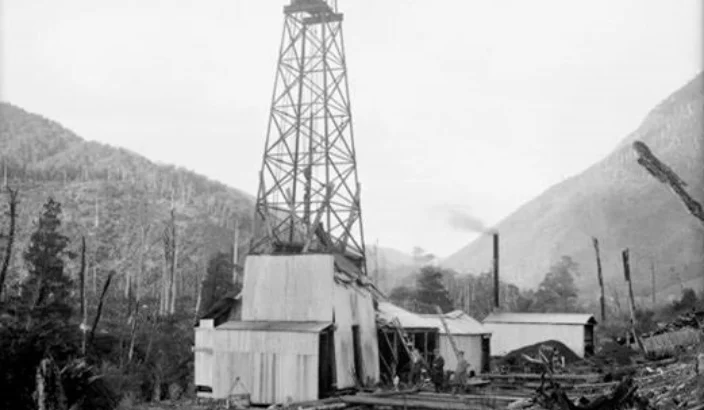
About 1920, Mr Bassett, a retiring mining engineer from Hokitika, made a visit to rugged country near Maruia, where he observed and collected a sample of oil seeping naturally from the ground.
The sample was forwarded to Wellington for analysis, with the results showing it to be good-quality crude petroleum. The find caught the attention of a Sydney-based investor, who travelled to the area. After considering the evidence, he returned to Australia and came back in early 1922 accompanied by a geologist to carry out further assessments.
After several days in the vicinity, the geologist concluded the oil-bearing sands lay at too great a depth below the surface to warrant boring. The party shifted its attention to the Mangles River area but did not remain long.
Bassett decided to continue investigations and, over the following two years, he and Mr Oxnam, along with Oxnam’s brothers, carried out extensive exploration.
John A. Spencer, formerly with the Anglo-Persian Oil Company, was engaged to oversee development of the field. However, in early 1924 he was working in New Guinea. In the meantime, geologist Sydney Fry was sent to continue examinations and prepare reports.
When John finally arrived, he undertook an exhaustive survey of the district and found signs of oil in promising quantities. He also concluded that a large prospective oil field existed in the Blackwater Valley.
By this stage, further progress depended on securing finance. The Murchison Oil Syndicate was formed in Auckland and, in October 1924, the area was gazetted as an oil field. H. D. Robertson of Auckland was appointed chairman of directors, E. J. Valentine as director and Bassett as manager.
In December 1924, prospecting licences were recommended to D. A. Oxnam and Bassett over an area of 20,000 acres for the prospecting of oil, petroleum and natural gases.
By September 1925, subscribers to the newly-formed company held rights over nearly 22,000 acres, primarily in the Mangles and Owen River districts. Two months later, a 30-ton boring plant, along with a boiler and drills, arrived from Australia. The equipment was railed to Glenhope and transported on to Murchison.
Mr Pederson arrived from Sydney to act as head driller and oversee the erection of the derrick.
Drilling began in the Mangles River area in April 1926. By May, the bore had reached a depth of 1,172 feet, when workers detected the smell of gas and observed visible traces of oil.
An investigation of 1,000 acres on the Blackwater River justified the decision to acquire further land for the company. In July 1927, samples obtained at depths of more than 2,300 feet were found to be highly inflammable and were sent to the government analyst.
By the end of 1927, the syndicate appealed for further capital to enable the purchase of 3,200 feet of five-inch casing and a new drilling cable.
In August 1928, H. Stewart, chairman of Murchison County Council, was alerted to an unusual feature in the Blackwater Valley, where a powerful jet of gas had been discovered. When set alight, it burned continuously for a week, maintaining a flame about four feet high.
The site lay about five miles from the company’s main drilling operations, offering yet another hint of the resources believed to lie beneath the ground.
