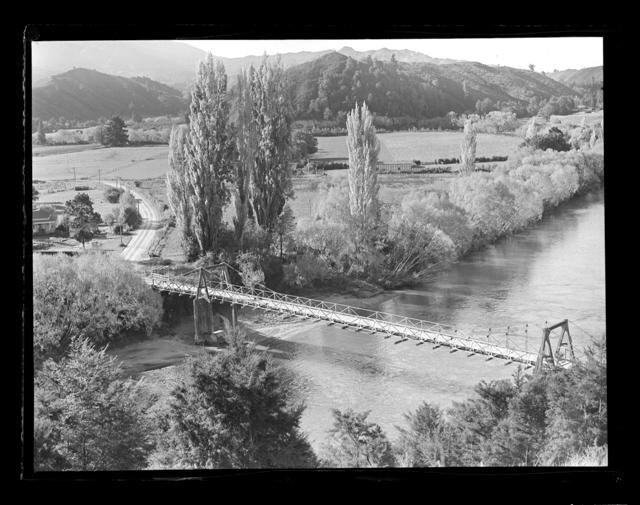
For early settlers in the Motueka Valley, bridges were more than infrastructure. They were lifelines, removing the danger and uncertainty of river crossings and connecting communities on opposite banks.
Nowhere was that need felt more strongly than near Ngātīmoti, where access between the east and west sides of the Motueka River was vital for daily life and farming. The first Peninsula Bridge, built in 1898, was swept away by flooding in October 1911.
Plans for a replacement bridge were drawn up the same year, but progress stalled when, in July, the designs were found to be insufficient. As a result, the county engineer was unable to order timber and construction was delayed.
Work finally began in 1912, only for further problems to arise. In January the following year, issues emerged with the concrete not mixing properly. After analysis, it was believed oil floating on the river surface may have been the cause.
After almost two years of waiting and coping with the challenges of an unbridged river, the new single-lane Peninsula Bridge opened in July 1913 at a cost of about £2650. For local settlers, the relief was immense. They no longer had to transport produce and goods across the river by punt, often at considerable risk.
About 300 people attended the opening, including Waimea County Council councillors, county engineer G. Whiteside, Motueka mayor Mr Simpson and the Hon. R. McKenzie, MP for Motueka. Locals and visitors gathered in a large paddock owned by G. Beatson.
The ceremony was performed by R. McKenzie, with Mrs Brewerton cutting a white ribbon stretched across the width of the bridge.
The bridge measured 275 feet in length, with a 10-foot-wide roadway. It was supported by six concrete piers and featured central hinges to allow for expansion and contraction in heat. A 10-ton weight restriction applied.
Funding included a £900 government grant, with £1100 raised through a council loan. The interest on £650 of that loan was paid by local settlers.
Within five years, the council was forced to intervene after it became clear larger and heavier vehicles were using the bridge. A bylaw was introduced to regulate its use.
By 1932, concerns were raised about deterioration, prompting the Ngātīmoti branch of the Farmers Union to write to the council. An engineer’s inspection deemed the bridge safe, but a six-mile-per-hour speed limit was imposed.
Three years later, the structure was declared unsafe and closed to all traffic. Wooden straining blocks were decaying, rot was found in parts of the towers, and defects were identified in the transoms. Engineers recommended dismantling the bridge, reconstructing the straining blocks in steel, replacing the timber and steel towers with reinforced concrete, and renewing defective timber, at a cost of £1200.
Its eventual reopening marked a significant day for the community.
In 2023, the settlement marked a 100-year celebration at the bridge, with horses, wagons, vintage cars and period farm implements crossing from the Ngātīmoti Memorial Hall, a reminder of the bridge’s enduring role in valley life.
