
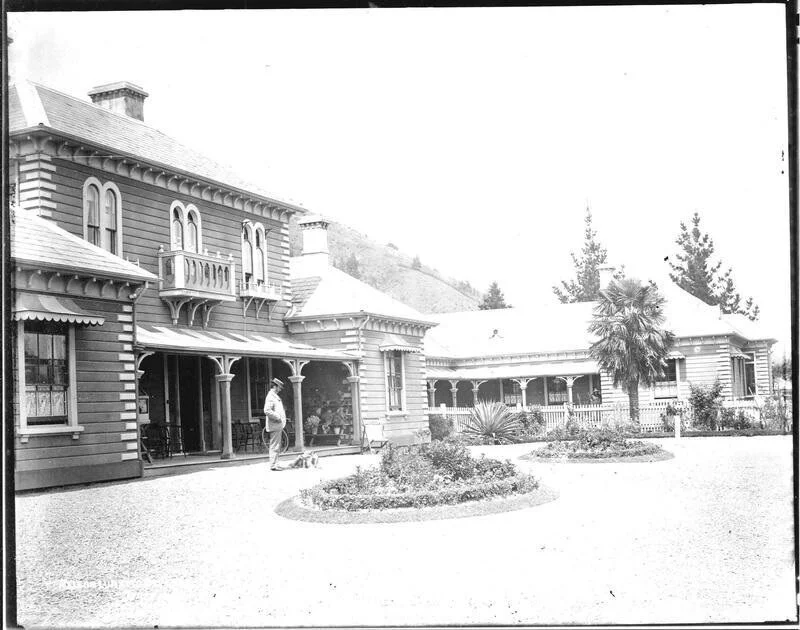
Plans for a lunatic asylum in Nelson were discussed in the earliest years of the settlement, and in 1855 a sum of £1000 for a colonial hospital and asylum was added to expenditure estimates.
Until that point, the local gaol served three purposes: a prison for debtors, a common gaol, and a place to hold those described at the time as ‘lunatics’.
Public opinion increasingly focused on the need for better accommodation for these unfortunates, and in May 1855 tenders were called for alterations to a house to adapt it for use as an asylum. That plan was soon halted when the General Government signalled its intention to establish a single asylum for the whole colony in a central location.
Nelson was still left without a suitable facility, and in early 1858 a committee was appointed to consider the immediate erection of a local lunatic asylum.
In December that year, the Provincial Council was advised that the General Government intended to proceed with a general asylum for the colony, with construction to begin on a site at the entrance to Poor Mans Valley in Stoke. Tenders were called in May 1858 for a temporary asylum near the hospital, intended to serve the district until the general asylum was completed.
By June 1860, plans had arrived from England for the proposed Government General Asylum. The design covered 100 acres and provided accommodation for 110 patients, 55 of each sex, along with multiple attendants. The complex included courtyards, airing rooms, gardens, a porter’s lodge and a physician’s residence, at an estimated cost of £30,000.
The proposal was ultimately abandoned after funding was voted down in Wellington. Instead, it was decided that each centre would be responsible for its own asylum.
That decision left Nelson in a difficult position. A structure had been altered as a temporary solution in the expectation that a central asylum would soon be built, but the small house in Shelbourne Street proved totally inadequate.
Although the Provincial Council passed a Lunatic Asylum Bill, progress was slow. In February 1864, tenders were called to lease land in Marsden Valley for 14 years, but the plan never eventuated.
Repeated cases highlighting the urgent need for a purpose-built asylum continued to emerge. In mid-1864 the council was authorised to borrow £5000 for the project. At the same time, the former Taranaki Refugee buildings opposite the hospital became available, and funds were spent altering and renovating them to a suitable standard.
When completed, the building contained two wards: one for males with 14 beds, and one for females with nine beds. Sixteen inmates were transferred into the new facility.
In 1867, the asylum’s keeper, R. Crawford, was dismissed following allegations of mistreatment of a female patient. He was replaced in 1868 by Thomas Butler.
By 1872, the buildings were again deemed unfit for purpose. In June that year, the provincial secretary secured a loan to purchase land and construct suitable new facilities. Between 1867 and 1873, 131 patients passed through the Nelson asylum.
The council eventually approved the construction of a new asylum behind the existing buildings, with five designs submitted for consideration.
