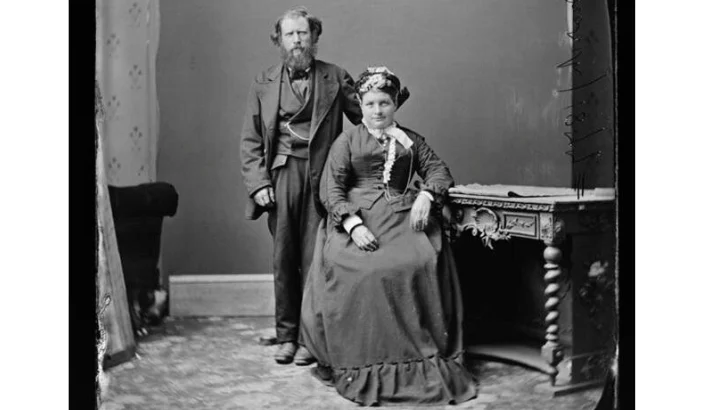
Christopher Remnant, his wife Anne and their two young children, Ann and William, left England and all that was familiar in search of a new life, arriving in Nelson aboard the Anne Dymes in March 1864.
By the time the ship reached port, the family had grown. Another child, George, was born at sea during the long journey. Two of Christopher’s brothers, George and James, were already in New Zealand, a factor that may have influenced the family’s decision to immigrate.
The Remnants settled on land in the Ngātīmoti district where, in late 1874, Christopher was appointed postmaster. Over the following years six more children were born to the couple: Emma, Sophia, Christopher, James, Henry and Alfred.
Life in this isolated rural area demanded extreme self‑reliance, hard physical labour and the constant responsibility of raising a large family while securing food and resources. Despite the challenges, Christopher and Anne met them head‑on.
Christopher was particularly vigilant in protecting his property. In 1876 he gave public notice that owners of cattle found trespassing on his land would be held responsible for any damage caused.
That determination was again evident more than a decade later. In November 1889, the Pokororo Road Board charged Christopher in the Magistrates Court with obstructing a public road by placing three logs across it. Christopher argued the road crossed land he had occupied since 1868 and that it had not been used during that time. Although the board removed the logs, Christopher replaced them. The court found in favour of the plaintiffs, imposing a fine of one shilling, along with costs of £6.
Despite such disputes, Christopher was described as a quiet gentleman of unassuming habits who was well regarded by those who knew him. He died in March 1905 and was buried at Motueka Cemetery. Anne lived another 22 years, passing away in 1927.
Their son Christopher, born in Ngātīmoti in 1871, grew up on his parents’ farm. About 1898, he took over a 350‑acre block of heavily-wooded land at Pangatotora, where he established his own home and a sawmill.
The mill was water‑powered, using an overshot wheel measuring 16 feet by five feet. White pine and rimu were milled and sold locally in Motueka, with between 1500 and 2000 feet produced each day.
Like his father, Christopher was staunch in defending his land and appeared in court on several occasions. Most notably, an ongoing dispute arose with Thomas Grooby, who asked the council to enforce what he claimed was a legal right of access across Christopher’s property. The claim was denied, but complaints and threats of prosecution continued for several years.
In 1907, Christopher married Grace Slatter, daughter of George and Rachel. The couple had at least seven children, two of whom died at a very young age.
Christopher took a keen interest in education at Pangatotora and served for many years as chairman and a member of the local school committee.
In August 1906, the freehold farm of 350 acres, along with a cottage, stable, barn, sheds and a blacksmith’s shop, was offered for auction, together with stock, tools and the sawmill. The property did not sell, and Christopher continued operating, selling firewood as late as 1914.
In 1936, Christopher and Grace moved to Motueka. He died there in July 1939, aged 68.
