
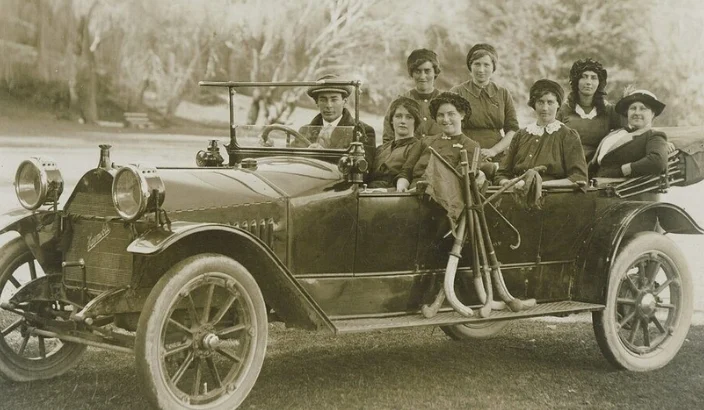
Travel over Tākaka Hill began as little more than a bridle track before gradually developing into a dray road and eventually a vehicle road, slowly reducing the isolation of Golden Bay. As movement around the district increased, the need for reliable transport services became clear, and several enterprising businessmen recognised the opportunity.
In December 1913, Norman Emms of Tākaka announced the beginning of his new business as a motor car driver, offering trips between Nelson, Motueka and Tākaka. Operating under the name Tākaka Motor Service, Norman purchased an eight-seater, self-starting Cadillac motor car fitted with modern electrical equipment and soon began running a regular service over the hill.
By early 1915 Norman had secured the Royal Mail daily service to Golden Bay, greatly increasing the importance of his business. He was assisted by his brothers Arthur and Charlie, who helped to drive and maintain the growing fleet.
The roads, however, were still dangerous. On one occasion Arthur attempted to pass another vehicle when the wheels slipped over the edge of the narrow road, causing the car to overturn and throw seven passengers clear. Fortunately, no serious injuries were reported.
As demand increased, Norman expanded rapidly. In May 1916 he added a second Cadillac capable of carrying 10 passengers. The new khaki-painted vehicle, powered by an eight-cylinder, 60-horsepower engine, was considered ideally suited to the difficult route over Marble Mountain. Later that year, another Cadillac joined the fleet after Norman secured the mail contract for a further two years.
The service timetable was also improved, with vehicles leaving Nelson earlier in the morning and arriving in Tākaka by early afternoon. Passengers travelling over the hill were even invited to stop at Motueka for morning tea during the journey.
The First World War created labour shortages throughout the country, and Norman struggled to retain skilled workers. In 1917 he appealed to the Military Service Board for the exemption of his mechanic, Stanley Stillwell, arguing that maintaining the mail service depended on keeping the vehicles operating reliably. Around the same time Arthur enlisted for military service and left the company.
By the end of 1917 the business had grown substantially, and advertisements appeared offering the company for sale as a going concern. Included were the Tākaka–Nelson daily mail service, five Cadillacs, an Austin car, a large garage capable of housing 20 vehicles, workshops, showrooms and a stock of motor and cycle accessories. Despite the advertisement, Norman retained ownership and continued operating the service.
The summer of 1918 saw the business running at full capacity. Streams of holidaymakers, along with soldiers travelling to and from military camps, packed the touring cars. It was not unusual to see three large vehicles leaving Tākaka together, loaded with passengers and luggage.
Norman continued to invest in improvements. In 1919 he installed an oil engine at his garage to power machinery including a lathe, air compressor and dynamo for lighting the workshops. That same year another accident occurred near Upper Tākaka when an Emms mail car collided with a vehicle owned by Mr Forno of Rockville. Several occupants were thrown from the car, and a 10-year-old girl was badly injured after being hurled through the windscreen.
The company continued to expand. In 1922 Norman introduced a daily return service between Motueka and Nelson via Mariri, and later diversified into tourist excursions around the district. By 1924 the business, now known as the Motor Mail and Carrying Service, had entered livestock transport. Norman designed a double-decker sheep carrier fitted to a Dennis truck and successfully transported 60 sheep from Uruwhenua to the Nelson Freezing Works in just five hours, before continuing to Blenheim to collect stud rams.
Not all developments were positive. In 1925, Norman’s accountant, T. B. Mason, was charged with failing to account for company funds totalling £136. Meanwhile, Charlie left the company in 1926 to establish his own twice-weekly lorry service between Nelson, Motueka and Tākaka.
Rumours soon circulated that Norman had sold his business to Newman Brothers. Although he initially denied the claims, by 1927 Newman Brothers had taken control of the service, marking the end of an important era in Golden Bay transport history.
