
As Christmas 1873 approached, families across Golden Bay were preparing for the festive season when tragic news spread through the district on Christmas Eve.
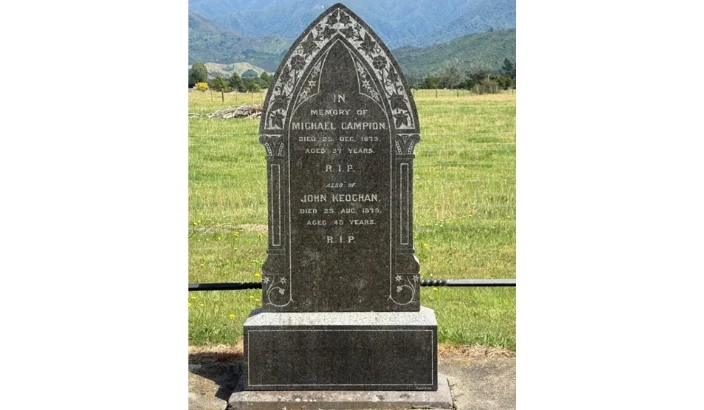
Michael Campion, a 35-year-old husband and father of two, had died following what was first described as a terrible accident. Within days, a young local man, Charles Lewis, was arrested and charged with manslaughter, sparking a hastily arranged trial and deep division within the community.
The incident occurred while Charles, Joshua Newport and Michael were carrying hay from a field to a stack. Charles was standing on top of the stack while Michael unloaded the cart below. By all accounts, the men had been in good spirits throughout the day.
Near the end of the work, Michael made remarks about a young woman Charles was seeing. Charles asked him to stop, but when the teasing continued, he became angry and threw his pitchfork down towards the cart.
Almost immediately, Charles heard cries from the others. Looking down, he discovered the pitchfork had struck Michael in the abdomen.
Michael was carried to a nearby house and a doctor urgently summoned. Despite medical attention, he died about ten hours later.
A hurried hearing followed, and a jury found Charles not guilty of manslaughter. The handling of the case quickly became controversial.
Friends and supporters of Michael were outraged at what they viewed as an informal and rushed inquiry before the coroner. Many also believed newspapers had largely ignored the seriousness of the tragedy.
Questions were raised about why the doctor reportedly refused to provide a certificate for the burial, as anyone burying a body without the registrar’s certificate could face a heavy fine at the time.
Although many in the district did not wish to see Charles harshly punished, they believed a fair and lawful inquiry should have taken place.
Michael’s death left his widow Mary and their two young children destitute. Members of the community attempted to raise funds to support the family, but several efforts were poorly attended and generated little money.
Criticism also fell on the Lewis family, particularly Charles, with some residents believing they held a moral responsibility to provide financial support to the widow and children. Charles’ father later stated the family had given direct assistance.
In January 1874, a large public meeting was held in the Takaka schoolroom to express sympathy for Mary and support James O’Reilly’s efforts to organise a relief fund.
James strongly criticised what he described as the unfeeling newspaper coverage, arguing that no attention had been paid to the suffering of the widow and her children. While some sympathy for Charles was understandable, he believed the greater concern should have been for the family left behind.
The meeting condemned the entire conduct of the inquest. Resolutions were passed calling for renewed fundraising, criticising the haste and legality of the inquiry, and arguing the District Coroner and Resident Magistrate should have been properly consulted before proceedings took place.
The minutes of the meeting were forwarded to the Minister of Justice, who subsequently ordered a government inquiry.
That inquiry later found proper procedures had not been followed. It concluded the District Coroner should have been informed, the acting coroner had failed in his duties, there was no reason for rushing the inquest on Christmas Day, and Charles should not have been granted bail so quickly.
Mary remarried in August 1876 to John Keoghan, and the couple had two children together. Tragedy struck again in 1879 when John was killed by a falling tree, leaving Mary widowed for a second time with four children to raise.
She never remarried and died at her East Takaka home on Sunday, 17 August 1923.
