
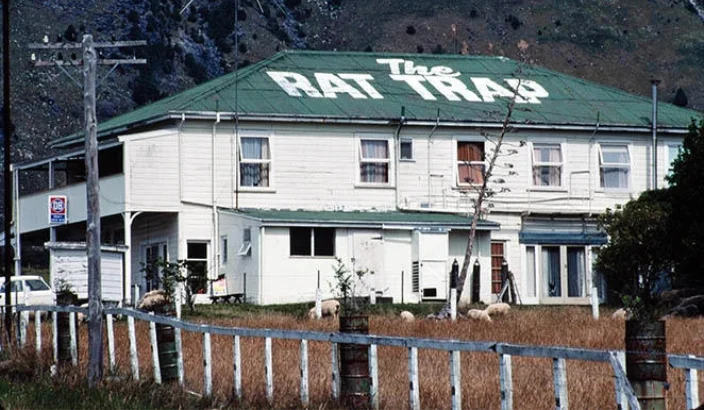
Upper Tākaka’s now-quiet roadside once echoed with coach wheels, thirsty travellers and the buzz of a hotel that became a Golden Bay legend.
In the early days of the dray road over Marble Mountain, the journey could take more than five hours, making Upper Tākaka an ideal stopping place. In 1877, Henry Bates built a large family home at the base of the hill for his wife and their 14 children. The house also provided lodging for travellers passing through the district.
As coach travel increased in the 1890s and settlement in Golden Bay expanded, the property became an important halfway house known as Forest Inn. The Bates family operated the inn until 1899, when James Septimus Harwood bought the property and applied for a hotel licence. Only a temporary transfer was granted after the legal process for a permanent transfer was not completed correctly. James had previously lived in Collingwood and worked as caretaker at the Spit Lighthouse.
In 1902, James advised the licensing committee of planned additions, including new bedrooms, a bar and a sitting room, although those plans were soon overtaken. The following year the original building was replaced with a substantial two-storey structure. James and his wife Robina remained until 1906, when he accepted a role as wharfinger at Waitapu Wharf.
Henry Heyward briefly took over the hotel, but after four years the Harwood family returned about 1910–11. Like many timber buildings of the era, the hotel faced the constant risk of fire. In May 1918, a blaze destroyed the barn, stables, outside buildings, tools and five tons of hay.
James Septimus Harwood died on 12 April 1927, aged 67. Soon after, his son, James Alexander Harwood, applied for an accommodation licence for what was by then known as the Upper Tākaka Accommodation House. James and his mother Robina continued to run the business.
The hotel drew attention in 1930 after an unusual court case. James and his sister Sylvia were charged with selling alcohol after hours. A constable, suspicious of activity, climbed through a window and found two glasses of beer on the counter. The charges were dismissed when the court ruled the officer’s entry amounted to breaking and entering.
In 1933, Constable Peter Berthelsen replaced Constable Lake in Tākaka. About 18 months later, he resigned from the police and took over the hotel from the Harwood family. Although granted the licence in 1935, ownership remained in Sylvia Harwood’s name. During this time the hotel became known as Peter’s Inn. Peter stayed about three years before leaving in 1938.
The licence later passed through several owners, including Robert Leslie Gear and Arnold James Profitt. Over the years the hotel was also known as the Post Office Hotel, with the local post office operating there from 1882 until 1947. By the late 1930s and early 1940s it had gained its most famous nickname, the Rat Trap. The name came from workers at the Cobb hydro-electric scheme, who would leave camp for a quick drink and often fail to return for days.
Many publicans ran the hotel over the decades, including Sonny and Maggie Keats, Trevor and Thelma Wells, Barry Burns, Paul and Susan Gibellini, Jan and Jim Paynter, and Allen and Ngaire Bolton.
On 19 May 1994, the Rat Trap was destroyed by an arson fire. Today, a private home stands on the historic site.
