
New Zealand’s School Dental Service was founded in 1921, in response to the poor state of children’s teeth and a growing focus on child health and welfare.
The idea for the service came from Colonel Thomas Hunter, director of the New Zealand Army Dental Service during the 1914–18 war. In 1921, he proposed that suitable women aged between 18 and 36 be selected and trained through a two-year course to work as dental nurses.
Clinics were established at schools across the country, serving children from surrounding districts.
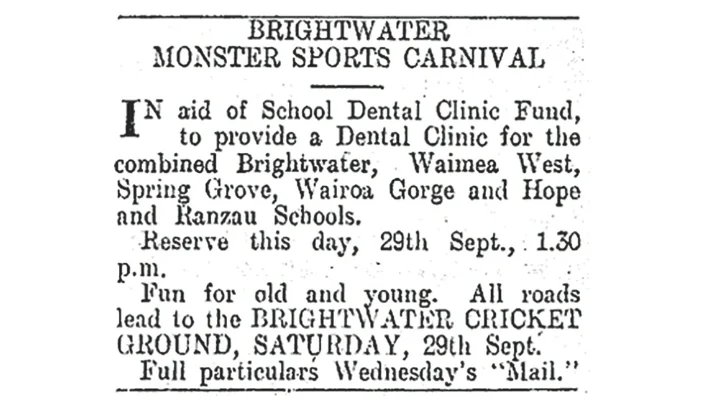
Brightwater School was among those keen to have its own clinic. In September 1928, plans were set in motion with a community-led fundraising effort to support children from Brightwater, Waimea West, Spring Grove, Wairoa Gorge, Hope and Ranzau.
A large sports carnival at the Brightwater Cricket Grounds was organised by a combined school committee to raise money for a clinic fund. The main attraction was a football match between the Pirates and a veteran Pirates team made up largely of original members of the old Hope Pirate team.
The veteran side claimed victory, and £40 was raised for the cause.
However, not everyone supported the idea. Some voiced concerns that a clinic at Brightwater would become a “white elephant”, proving costly and of little use to the school or its pupils.
This scepticism stemmed from an earlier effort in 1925, when the old Upper Moutere public school building was relocated and converted into a dental clinic to serve four school districts. Although the building was furnished through public donations, it operated only for a few years before closing, forcing children to travel to Motueka for treatment.
Despite the doubts, a subsidy from the Department of Education was approved for the Brightwater project. F. G. Robertson won the tender to build the clinic for £86.
At the same time, concerns were raised in Wakefield about the lack of dental services for local children. While some schools received visits from a dental officer, others – including Wakefield, Wai-iti and Foxhill – had no access at all.
Delegates pushed for a dental nurse to be based in Wakefield, noting that earlier access to a visiting dentist at the Technical School had ceased, leaving an urgent gap.
Later in 1928, approval was granted for a Wakefield clinic. Representatives from surrounding schools met to determine each community’s contribution, with Wakefield parents asked to raise £17 towards the cost of building and furnishing.
Local resident William Stringer stepped in and paid the full amount, relieving families of the financial burden.
By late 1929, the Wakefield clinic had been completed at a total cost of £110, with residents contributing £33 and the Government covering the remainder.
The school dental scheme proved highly effective in improving children’s oral health, although it was not always warmly received by its young patients, who sometimes referred to the clinics as the “Murder House”.
Nearly 90 years later, the system underwent a major overhaul. Between 2010 and 2012, many school dental clinics were phased out and replaced with centralised hubs and mobile dental vans under a renewed focus on good oral health.
