
The establishment of the Motueka Lime Company Ltd marked a significant step forward for local farmers, bringing much-needed lime production to the district.
An important component of a farmer’s life was the use of lime for agricultural purposes. In July 1917, an industry was announced with the formation of the Motueka Lime Company Ltd, created to pulverise and burn limestone sourced from deposits at the foot of the hills in Riwaka.
By mid-July, close to 1000 shares had been applied for. Certain rights and privileges were secured in the Riwaka district, and the company operated as a co-operative concern.
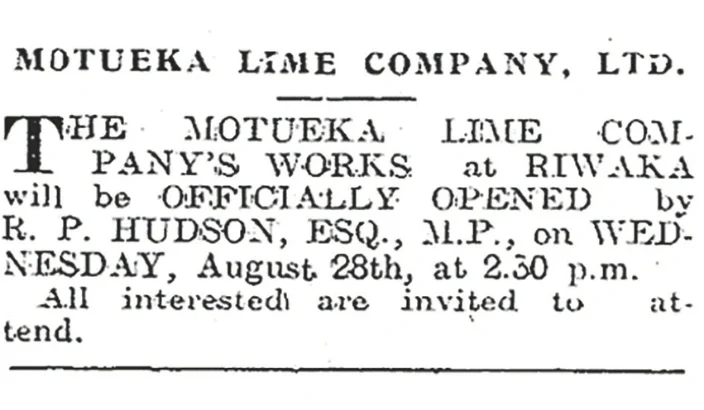
The formal opening, held on 28 August 1918 by R. P. Hudson, MP, was seen as an important step for the benefit of the whole district. Lime was in strong demand among agriculturists, pastoralists and horticulturists, but had previously been difficult to obtain, limiting its use.
The opening of the works at Riwaka, along with the development of deposits at Kaka, promised to supply lime to both the Motueka district and the Waimea Plains.
The Riwaka works began on a small scale but had scope for expansion. Limestone was shattered and placed in a bin, where a Jeffery pulveriser, driven by an oil tractor, crushed it into a fine powder before it was lifted into storage. A key advantage was that the stone could be quarried and crushed immediately, eliminating the need for drying kilns.
Directors of the company were P Lomax, T Hewetson, F Nottage, C Henderson, C Mackay and A Allport, with T Cooper as works manager. The Nelson Co-operative Fruit Company was appointed as the distributing agent.
The initial plant was temporary, with plans to replace it with a larger facility that would reduce the price of lime by several shillings per ton. The company also considered installing a kiln due to demand for burnt lime for uses such as spraying. Output at the time was about 40 tons a week.
A suction gas plant was later introduced, expected to save £300 a year in operating costs and increase output to three times its existing level. As a co-operative, shareholders were guaranteed priority supply and were entitled to a ton of lime for every share held, at a lower price than non-shareholders.
At the first annual meeting in December 1919, the company reported it was unable to show a credit balance from the year’s operations. Output had been heavily restricted by the poor condition of the Riwaka bridge, which could only carry very light loads, limiting production and preventing the plant from operating profitably.
Despite this, the plant was producing about 50% more lime per day than originally anticipated when the machinery was installed.
Future plans included the potential establishment of a depot at either Mapua or Motueka port, allowing settlers to access supplies more easily without travelling to Riwaka.
