
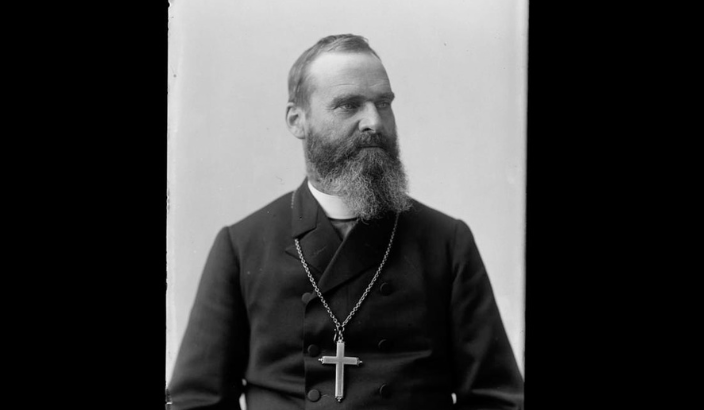
Francis Redwood was just three years old when his parents, Henry and Mary, and eight siblings left England in search of a new life on the other side of the world.
After five months at sea, the family arrived in Wellington aboard the George Fyfe in 1842 before sailing on to Nelson, where they were greeted by a fledgling settlement surrounded by bush and untamed land. One son, Joseph, stayed behind in England to complete his studies to become a veterinarian.
Henry set out to find suitable land and settled at Waimea West. The journey there involved travelling by boat, followed by a walk-through fern and mānuka for about a mile. The experience proved exhausting. Francis later recalled how his mother, on seeing a small New Zealand daisy, cried: “See what a beggarly country you have brought us to – it can’t even grow a decent daisy.”
At the site, the family quickly sank a well and erected a tent. The structure stretched 60 feet and was divided into compartments with boarded partitions, covered with canvas and secured by ropes to stakes in the ground. They lived there for six months before building a modest homestead.
In 1866, the Redwoods built a more substantial home, Stafford Place, reflecting both their growing status and improving economic position in Nelson.
As a young boy, Francis worked alongside his father and brothers on the family farm. During harvest, they were in the fields reaping about half an acre a day with a sickle.
The family initially focused on producing beef, dairy, mutton and horticultural goods for the Nelson market. Henry Snr and his son Henry also imported, sold and raced thoroughbred horses, with Henry Jnr later becoming known as the Father of the New Zealand Turf.
Francis showed academic promise and enrolled at Father Garin’s boarding school in Nelson in 1850. Once a month, he walked 14 miles home for a weekend, crossing the Waimea River on foot, before returning the same way on Monday.
Recognising his potential, Father Garin approached his parents about further education. At 15, Francis was sent to France. When leaving New Zealand, he shook hands with Pilot Cross. Twenty years later, on his return, the same man was there again to greet him.
After completing his studies in France, Francis moved to Ireland, where he studied for 10 years. He was ordained as a priest and confirmed his religious profession in the Society of Mary in early 1864.
In 1874, he was appointed Bishop of Wellington, rising through the ranks of the Catholic Church. By May 1887, he had become Archbishop.
By 1895, Francis was the senior New Zealand bishop. His role was wide-ranging, overseeing the placement of priests, staffing of schools, the Māori mission and diocesan finances.
In 1924, his golden jubilee as bishop was celebrated enthusiastically across the Nelson district. At that time, he was appointed assistant at the pontifical throne, a rank just below that of cardinal.
After a lifetime of service, Francis died on 3 January 1935 at the age of 96.
