
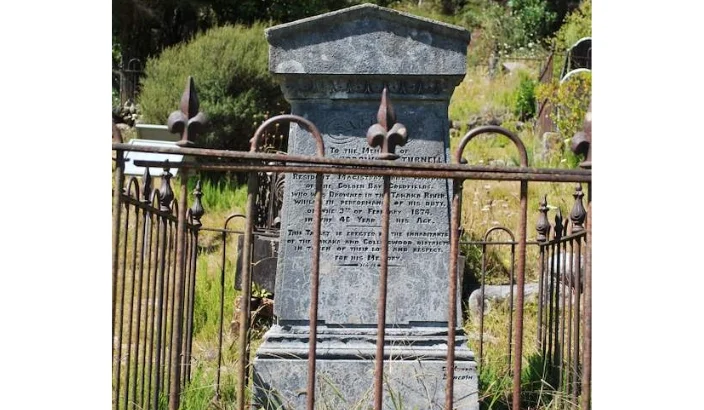
Henry Widdowson Turnell arrived in Nelson in February 1859 aboard the Midlothian and soon became one of Golden Bay’s most relied-on figures.
Settling quickly into life in the region, Henry took on numerous roles and became known for his commitment to the community. As a surgeon, his services were frequently called upon, travelling across Golden Bay at all hours to attend everything from minor cuts and bruises to serious accidents, burns and broken limbs.
His professional skill and popularity led to a string of public appointments. In 1864, Henry was named resident magistrate for Collingwood and coroner, roles that placed him at the centre of some of the district’s most tragic events.
One of his earliest cases as coroner was the death of goldminer Thomas Coster, who drowned while crossing the Takaka River. Another was the death of 13-year-old Thomas Ricketts, son of Ambrose, who was found near his home after suffering a gunshot wound. The inquest found a gun leaning against a tree had discharged when the tree was felled, killing the boy. A verdict of accidental death was returned, though exactly how the gun fired was never proven.
Verdicts could be phrased in unusual ways. In one case involving a man who took his own life after his wife left him, the jury concluded “the deceased committed suicide while labouring under temporary excitement.”
Henry’s responsibilities continued to grow. In 1865 he was appointed registration officer, road board member, trustee for the public cemetery in Collingwood and returning officer for the Takaka district. The following year he became a justice of the peace, registrar of marriages, births and deaths for the district of Aorere, postmaster and gold warden for Collingwood.
In later years he was appointed vaccination inspector under the Public Health Act 1872, overseeing smallpox prevention measures.
In February 1874, Henry had been carrying out his duties as coroner at the Takaka courthouse. After finishing in the afternoon, he set off for Collingwood but stopped at Waitapu to wait for the tide to fall before attempting to cross the Takaka River.
He left at 7pm but had not returned home by the following morning. A search party was organised, finding his horse on an island at the mouth of the river, its bridle broken and both stirrups gone. The horse was known to be restless in water, and it was believed it had reared and thrown its rider.
When Henry could not be found, plans were made to drag the river. His body was later discovered just below the second fall of the Takaka River.
In a tragic turn, the man who had presided over so many inquests became the subject of one himself. Overseen by Mr Sparrow, the verdict of accidental death was returned.
The community was left mourning a man held in the highest esteem.
