
When the Salvation Army arrived in Nelson in February 1884, it did not slip quietly into the town's religious life. Its arrival caused a considerable stir.
The Army's first meetings were held in the Temperance Hall, where large crowds gathered to see and hear these new and unfamiliar preachers. Not everyone was impressed.
Some newspaper reports described the meetings as jarring and even revolting, particularly because of the way the Salvationists spoke and sang about Christ with what was considered extraordinary familiarity and a lack of reverence.
To many Nelson residents, the Salvation Army was loud, unconventional and unsettling. Yet the crowds continued to come.
Concern soon began to spread about what some people considered the undesirable effects of the Army's activities. There were fears the excitement of the meetings might affect people of weak constitution, while others worried household duties were being neglected by those who spent too much time attending Army gatherings.
The Army's processions through the streets created another source of controversy. The noise of the meetings and marches caused some councillors to fear Nelson might become known as the most "larrikin" town in New Zealand.
Councillor Kerr even suggested a law should be passed requiring the Salvationists to go to bed at a certain hour, with all proceedings ending by 10pm.
The issue was debated at council meetings, with councillors divided in their opinions. One proposed bylaw suggested no person should form or take part in a procession in the public streets of Nelson, except members of the military and volunteer forces.
Opposition to the Salvation Army soon took a more organised form. A group known as the Skeleton Army was established specifically to harass the Salvationists.
The group was made up largely of men and boys who used offensive language and violence against the Army. Men were encouraged to buy tin whistles and collect anything else that could be used as "ammunition" in the coming battles.
The opposition was not confined to the rougher elements of the town. Some publicans and people from more respectable backgrounds encouraged the group, but many Nelsonians felt differently and defended the Salvation Army.
Mayor C. Fell, together with councillors, the Town Clerk and several ministers, turned out to protect the Salvation Army during one of its processions through the town.
In time, it became clear it was not the Salvation Army that had set out to create trouble. The disturbances had been caused by those who deliberately provoked the Army. Eventually, the Skeleton Army faded away.
By 1911, the Army had become a well-established part of the Nelson community, and the local corps celebrated its 27th anniversary that year.
Its practical work eventually earned the respect of many who had once viewed it with suspicion.
The remaining challenge was the need for a more suitable building. The existing barracks were no longer adequate.
In April 1911, a public meeting was held in the Council Chambers to discuss the proposal. A building fund was established and a section with an 80-foot frontage was secured in Waimea Street, near the junction with Bridge Street.
By September, work on the new building had begun. The first sod was turned by Ensign Bladin.
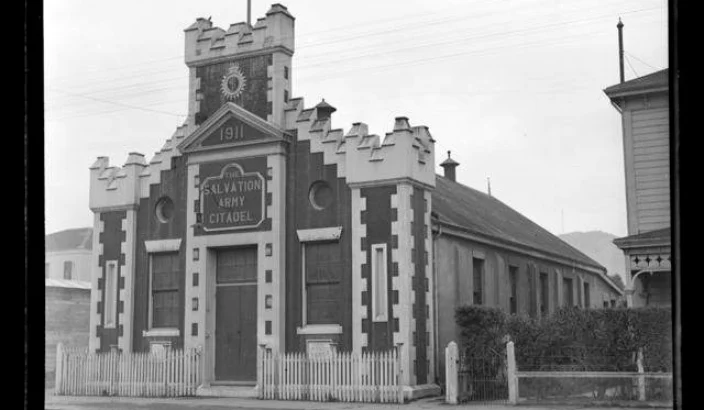
The new barracks were designed to provide seating for about 350 people in a main hall measuring 60 feet by 30 feet. Constructed of brick, the building was deliberately plain in appearance, making it simple but pleasing to the eye.
On 6 December 1911, the new Salvation Army Citadel was officially opened. A large crowd attended the ceremony, which was conducted by Mayor T. A. Field.
The opening of the new citadel cemented a remarkable change in the fortunes of the Salvation Army in Nelson. Twenty-seven years earlier, its arrival had been greeted with ridicule, anger and organised opposition. By 1911, the Army had earned a permanent place in the community and was opening a substantial new building to continue its work.
