
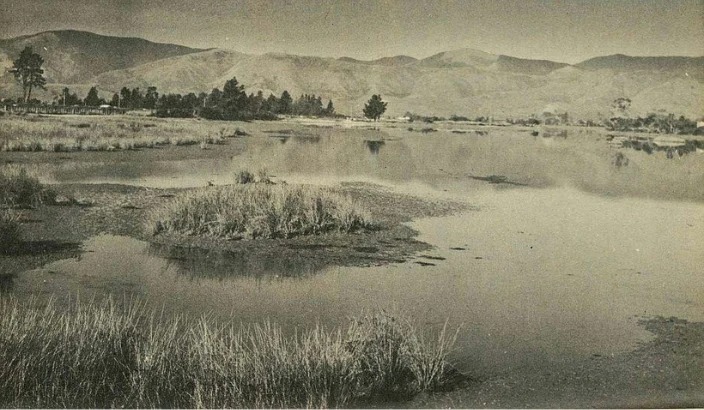
Rough Island, on the southern side of Rabbit Island, is today a popular destination for dog walkers and home to an equestrian park. Few visitors would realise the island was once home to two solitary fishermen.
In 1869, the island was gazetted as a gravel reserve. The first known resident was Joseph Darinovich, better known as Joe Darby.
In December 1880, Joe applied for a licence to occupy 50 acres at the eastern end of the island. His application was granted at an annual rental of £2 10s.
Joe built a small shack and made his living catching fish, selling them as far away as Belgrove. He also kept pigs, and grew tobacco and vegetables on the island.
After living there for 24 years, Joe became a naturalised British subject in late 1904 at the age of 65. His naturalisation papers recorded that he was of Austrian descent.
During his years on Rough Island, his only neighbour was another fisherman who lived at the opposite end of the island.
When Joe died in 1905, a group of local men inspected his home and discovered he had lived in extremely poor conditions.
His hut consisted of just two rooms, with the dividing wall supported by mānuka poles beneath a fragile roof. Both rooms were crammed with tins, boxes and all manner of rubbish, making it difficult to move about. The stone-and-mud chimney had collapsed, and among the more curious discoveries were Joe's homemade wooden boots, with soles almost two inches thick.
Rumours had long circulated that Joe had accumulated some wealth.
Shortly before his death, he reportedly told a clergyman he had buried his money near the hut. The day after his death, an envelope was found a few feet from the chimney bearing the inscription: "We have found old Joe's money; 28 sovereigns; in a tin in the ground — The S. and F. Company."
Whether the note was genuine or a hoax was never established.
The envelope was handed to the local constable, who began inquiries into the mysterious "S. and F. Company". The initials were humorously interpreted as standing for the "Seek and Find Company", and the "manager or any shareholders" were requested to report to the Richmond Police Station. No-one came forward.
The island's second resident was Antonio (Anthony) Weler, who, like Joe, earned his living as a fisherman.
Records indicate Antonio was born in Oporto (Porto), Portugal, about 1841. He was 64 when he became naturalised.
In 1905, Antonio left Rough Island intending to settle in Auckland. He soon found he did not like the city and returned to his island home.
What became of him after that remains unknown, although it is possible he later left the Nelson district.
In 1920, Rough Island's status changed from a gravel reserve to a plantation reserve, with the land vested in Waimea County Council.
As the island was considered largely wasteland, the plantation was intended as an experiment.
