
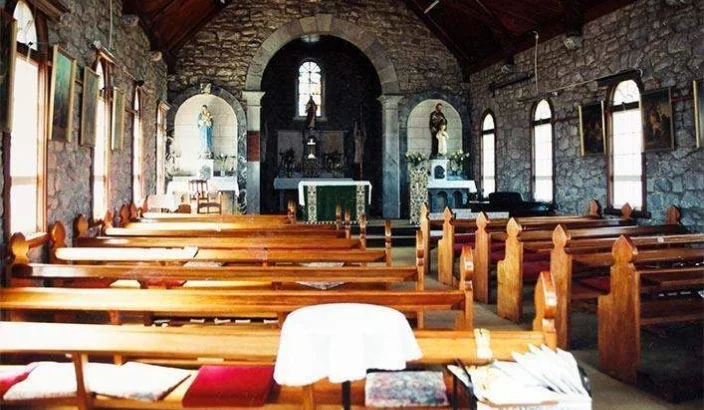
Tākaka's Catholic community spent years raising funds before opening its marble church in 1918, exactly 50 years after the district's first Catholic church welcomed worshippers.
From the earliest days of European settlement, Golden Bay's Catholic community was served by visiting clergy, with services often held in residents' homes.
In 1867, parishioners met to discuss the need for their own church and, in November that year, tenders were invited for the construction of a Catholic church in Tākaka.
J. Riley of East Tākaka offered a site for the building, as did W. Windle on the opposite side of the river. Windle's property was considered the better location, and his offer was gratefully accepted.
Applications for funding were made to Catholic communities in Nelson and Waimea, as well as to the trustees of local trust funds, and were successful.
On 15 September 1868, the new church was opened by Rev. Father Chareyere. Built by R. Stewart of Nelson in the Gothic style, the structure measured 30ft by 18ft and featured two stained-glass windows.
In late 1871 a cemetery associated with the church was consecrated. Trustees Eric Sparrow, James Reilly, Michael Campion, Michael Hoolihan and Patrick Byrne oversaw its administration.
Forty-two years later, in September 1910, Tākaka residents were eagerly awaiting the completion of two new churches. One was the Church of Christ on the site of Fabian's old store, while the other was a new Catholic church next to the police station.
A small footnote in a newspaper report at the time raised questions about the district's spiritual well-being, stating: "It is to be hoped that these churches will be better supported, or their prospects will not be over bright."
Determined not to take on debt, Catholic parishioners decided construction would not begin until sufficient funds had been raised.
In December 1911, a two-day bazaar raised about £140, but it would be several more years before building work got under way.
Construction finally began in August 1917, although progress was slow. By April the following year the outer walls had been completed, and roof tiles were being made on site.
Excitement filled the district on Sunday, 15 September 1918, when the Church of the Sacred Heart was formally opened.
Services were held in the morning and afternoon, followed by a solemn benediction delivered by the archbishop. Between services, visitors were entertained at lunch at the Junction Hotel, and a sacred concert was held in the evening.
By the close of the day, it was announced that the remaining debt on the church had been paid in full.
The new church was noted for its simple yet striking design. Measuring 60ft by 27ft, its side walls stood 14ft high, while the front rose 35ft from base to peak. The building could accommodate 200 worshippers.
The marble used in its construction was generously donated by Mrs Eric Sparrow of Uruwhenua from a quarry on the family's property.
The church was designed by A.R. Griffith of Nelson. Carpentry work was overseen by Mr Greenam of Nelson, while the tiles were produced by Chamberlain and Stannard of Nelson.
