
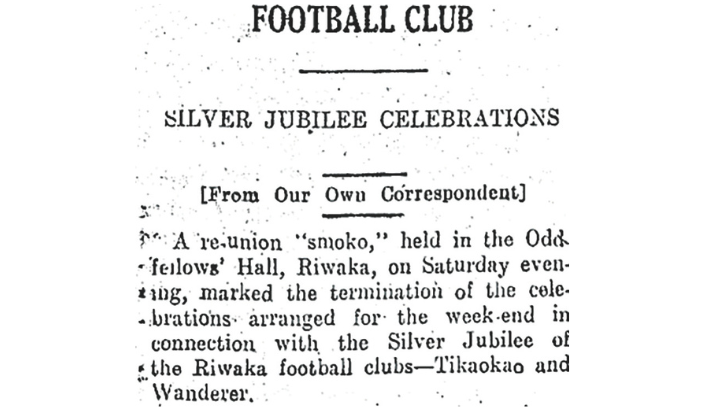
Rugby in Riwaka has a history stretching back to the 1880s, but by the time Wanderers and Tikaokao celebrated their Silver Jubilee in 1937, the game was facing fresh challenges.
The two clubs marked 25 years since their formation with a ball at Brooklyn Hall, an event designed not only to celebrate the past but also to spark renewed interest in football, which was beginning to lose some of its popularity in the district.
The roots of rugby in Riwaka ran deep. The original Riwaka Football Club was formed in 1887 and, about 45 years before the Jubilee celebrations, one of the earliest matches between Riwaka and East Tākaka was played in Cook's paddock.
In the club's early years, teams competed for the Golden Bay District championship against sides such as East Tākaka and Collingwood, while also taking on Nelson teams from time to time.
In 1899, Motueka residents George Jenkins and Joseph Leonard donated a silver cup for competition between Motueka and Riwaka. After a period in which the club mainly played friendly and scratch matches rugby steadily gained popularity, and the Riwaka club entered a team in the Nelson junior competition about 1903.
Travelling to Nelson for matches was no easy task. Players rose at 6am to catch the steamer and, on at least one occasion, went straight from the boat to the football field to play.
Membership continued to grow and, by 1906, Riwaka was able to field a second junior team in Nelson.
A new club emerged in 1909 when Kia Ora Football Club was formed to compete in the Nelson senior championship. Made up largely of players from Riwaka, the team went on to win the senior cup.
Another major change came in 1911 with the formation of a sub-union and the creation of two new clubs, Wanderers and Tikaokao. Wanderers represented the Brooklyn and Umukuri area, while Tikaokao was based in the wider Riwaka district.
Riwaka and Kia Ora continued to compete in the Nelson senior competition until 1912, when both clubs folded following the establishment of the Motueka Sub-Union. The new organisation brought together teams from Wanderers, Tikaokao, Huia, Whakarewa, Dovedale and Rangers.
For the next 24 years Wanderers and Tikaokao remained separate clubs, before amalgamating in 1936, leading to the reformation of the Riwaka Rugby Club.
The Silver Jubilee celebrations the following year provided an opportunity to reflect on the district's rugby heritage. An old-timers' match was followed by plenty of reminiscing, including stories from Albert Askew, who had been 20 when some of the earliest matches between Riwaka, Takaka and Nelson were played.
Albert entertained the gathering with tales from the pioneering days of football and offered some pointed observations about the modern game.
He told younger players that standards had declined because they were not putting enough effort into training and boldly claimed that, given a week's preparation, the old-timers could still beat the best team in the competition.
His message was direct: the younger generation was capable of better performances but needed to be more committed to training.
From the original Riwaka Football Club of 1887, through the years of Wanderers and Tikaokao, the district's rugby story is one of changing clubs, long journeys and dedicated players. The reunion of the two clubs in 1936 helped lay the foundations for the Riwaka Rugby Club that remains part of the community today.
