
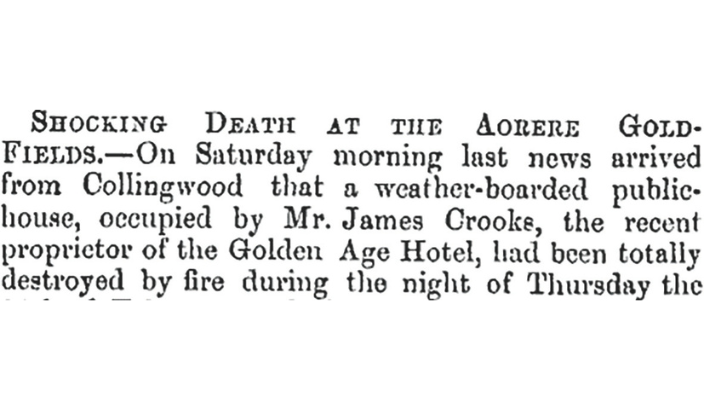
In the early days of March 1861, the small settlement of Collingwood was gripped by a tragedy that sparked rumour, suspicion and a lengthy inquest.
James Crook, publican of the Golden Age Hotel, died in a fire that destroyed the building. But exactly how the blaze started, and whether anyone else was involved, remained unclear.
As evidence was gathered, investigators established that all the hotel’s doors had been bolted from the inside. The fire was believed to have started in a corner between the bar and a bedroom. Crook’s body was found in the rear corner of the main building, which was the last part of the hotel to be engulfed by flames.
Testimony revealed that Crook and his common law wife, Amelia Robinson, had been quarrelling in the days leading up to the fire over the deeds to the hotel, which Amelia refused to hand over.
According to Amelia, Crook had assaulted her, causing her to flee to a neighbour’s house. On the night of the fire she claimed he threatened her with a knife unless she agreed to marry him. After he calmed down, Amelia said she left the hotel and went to the home of the Bain family, who lived a short distance away.
A former hotel barman, Richard Gobby, gave evidence that he had heard frequent arguments between the couple during his time working there. Gobby, who had left his job a week before the fire, said he heard crackling noises during the early hours of the morning and discovered the hotel ablaze.
He told the inquest he broke into the building but could not find anyone inside, so left to raise the alarm.
It was noted during proceedings that Gobby, who had been living at the hotel, had recently been told by Crook to find somewhere else to live after losing his job.
The destruction of the hotel and the location of the body raised further questions. Crook’s remains were found in an area that caught fire late in the blaze, prompting speculation over why he had not attempted to escape before the flames reached him.
A knife and a packet of matches were discovered beside the body.
Witnesses were called to build a picture of the couple’s lives and Crook’s state of mind. Amelia told the inquest he was often intoxicated and had been drinking on the night of the fire. Other witnesses disputed that account.
Several people testified that Crook appeared sober, sane and in his usual spirits that evening, although many agreed the couple’s arguments were frequent.
Further evidence showed Amelia had removed some of her belongings from the hotel about a week before the fire, taking them to the Bain household for safekeeping. She had also spent that night away from the hotel.
Mrs Bain told the inquiry that Amelia had warned her the evening before the fire that if anything happened to her, people should know Crook had been threatening her.
Other witnesses alleged Amelia was often intoxicated and had made remarks suggesting she would be better off without Crook.
Constable Reardon, who attended the scene, told the inquest he observed specks of blood on Gobby’s clothing and on Amelia’s nightdress. He also questioned why Amelia had removed possessions from the hotel shortly before the fire.
Despite extensive testimony, the inquiry was unable to determine the precise cause of Crook’s death. The verdict was accidental death by fire, accompanied by a statement that there was every reason to believe the body recovered was that of James Crook.
Officially, the matter ended there.
However, a detail noted in the months after the inquest ensured the case remained a topic of local discussion. Just a few months after the fire, Amelia and Richard Gobby were married.
