
Built during World War II, Motueka’s dehydration factory processed hundreds of tonnes of apples for American troops and later became a cornerstone of the town’s food-processing industry.
During World War II, the Government was asked to help provide food for American troops stationed in the Pacific. Supplying perishable food to hot climates was a major challenge, and dehydration proved to be the ideal solution.
Plans were developed for four dehydration factories across New Zealand, each specialising in particular fruit and vegetables. Motueka was chosen as the site for apple dehydration.
Construction began in late 1943 on land adjoining Thompson and Hill’s fruit factory in High Street South. Thompson and Hill already had experience drying apples, a process similar to dehydration, and it was anticipated their staff and management would assist with the new operation.
Designed by the Government Architect’s Department, the factory was completed in June 1944. It was built to process 50,000 bushels of apples, including Statesman, Granny Smith, Sturmer, Ballarat and Washington varieties.
The weatherboard building measured 192ft by 65ft. The western section facing High Street was two storeys and housed the main entrance, staff rooms, offices and a can store. The main factory floor was reinforced concrete sealed with silicate of soda to withstand fruit acids.
The building was divided into three sections: receiving, manufacturing and packing.
The manufacturing department contained a single tunnel dehydrator. Its lower section was built from concrete while the upper section was made from asbestos sheeting with an outer covering of Pinex board. The dehydrator included heating units, air-circulating fans, an air duct connected to the roof-top filter room and exhaust ducts.
A return track allowed trucks carrying trays of fruit to enter the dehydrator at one end and emerge at the other with the product fully processed. Once unloaded, the trucks could immediately begin the cycle again.
The preparation line followed a U-shaped layout. Apples passed through peeling and coring machines before moving to trimming tables, slicers, bleaching equipment and finally the tray-loading conveyor. Finished product was held on the ground floor before being transferred to the packing department for dispatch.
Despite a shortened first season because the factory did not begin operating until June, 810 tonnes of fresh apples were dehydrated in 1944. The finished product was sent to Allied forces in the Pacific.
A hostel accommodating 50 female employees working in both the dehydration and tobacco industries was completed and officially opened by Lady Newall in April 1945.
Later that year, in October, additions were approved that expanded the factory by 1300 square feet for the storage and dispatch of finished products.
As the war came to an end, attention turned to the factory’s future. Options considered included quick-freezing and juice extraction.
A change of ownership followed in 1949 when the plant was sold to J. R. Butland.
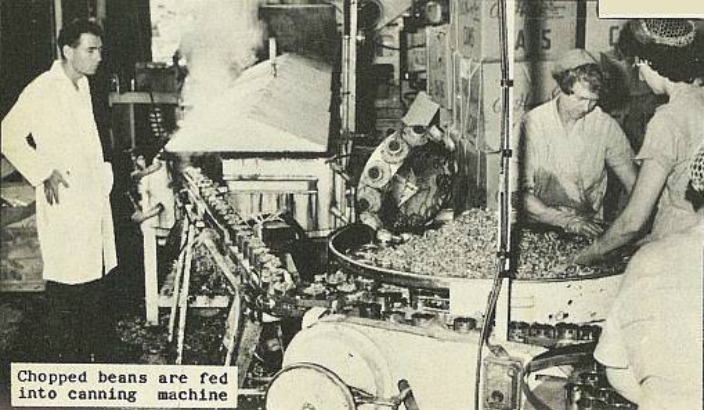
Quick-freezing of peas and beans began in 1954. Initially, produce was frozen in blocks before free-flowing freezing methods were introduced. During the first season of the new process, the Motueka plant operated canning, dehydration and quick-freezing facilities side by side.
Business mergers and industry developments, including the formation of NZ Foods Limited in 1961, eventually saw the Motueka plant become part of the Unilever business and closely associated with the Birdseye Foods brand.
The factory became well known for dehydrating peas, marketed as Surprise Peas, and for canning fruit. Locals often referred to it simply as the Unilever factory or the Motueka dehydration plant.
After more than four decades of food processing, the factory closed in September 1986, ending a significant chapter in Motueka’s industrial history.
