
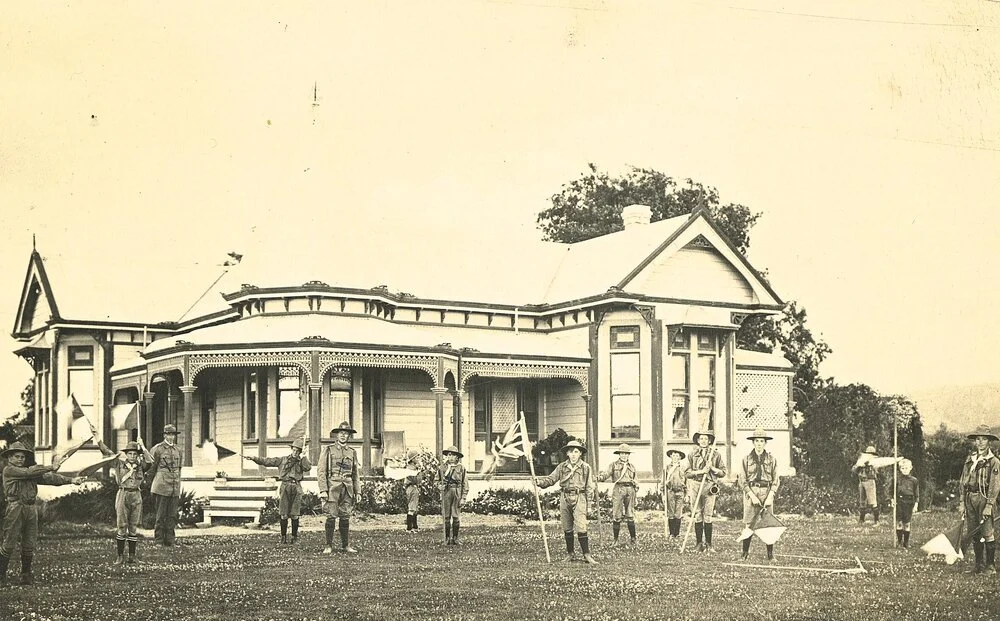
The Scout movement arrived in New Zealand in 1908 with a mission to foster peaceful citizenship, discipline and outdoor skills in boys. It aimed to build character, self-reliance and physical development.
The movement quickly spread across the country, reaching both major centres and small settlements. By about 1911, scout troops had been established in Motueka and Riwaka.
A strong advocate for scouting, James William Thomson became scoutmaster of the Riwaka troop. That year, his 30-strong troop was instructed in flag signalling by assistant scoutmaster Sergeant Craven.
In April 1912, the troop, consisting of 21 boys in three patrols, was inspected by District Commander Dr A. Paxton.
Teddy Owen led the Moreporks patrol, with Douglas Askew as corporal. Mostyn Chittenden led the Weka patrol, with Jack Holyoake as corporal. The Grey Duck patrol was led by a young Keith Holyoake, with Ivan Thomson as corporal.
Interest remained strong for a time but, by 1931, the troop had almost ceased to exist.
In an effort to revive scouting in the district, District Commissioner W. Johnston, Provincial Secretary Holden Webb, Mr Toomer, scoutmaster, and scouters Davis and Chivers travelled to Riwaka. A meeting at the Presbyterian Church enrolled scouts and cubs into a newly-organised movement.
The first birthday of the re-established troop was celebrated in October 1932 with a day of games and entertainment.
First-year stars were awarded to Roy McCarthy, Clarence Wilkinson, Pat Rowling, Ron Fry, Pete Rowling and Ron Scott. Ron also received the award for best all-round scout.
Mr L. Cederman was appointed scoutmaster and Miss S. Cederman cub mistress. However, both remained in their roles for only a year.
Interest again waned quickly and, in 1933, recommendations were made to reorganise the troop and inject new life into the movement.
Weekly gatherings on Wednesday evenings and Saturday afternoons began under joint scoutmasters B. Hickmott and C. Ballard. Despite these efforts, scout numbers continued to decline and community leaders searched for ways to rebuild interest.
The troop's 1933 annual report reflected another significant drop in participation, with an average attendance of just nine boys.
Parades held during 1932 ceased in mid-December. A combined Motueka-Riwaka scout camp was held at the end of January, with about 10 Riwaka scouts attending.
By mid-1933, Wednesday evening parades were continuing, but Saturday parades had stopped because no leader was available. At the end of July, poor attendance and a lack of interest led to all parades being abandoned, and a motion was put forward to disband the troop.
There was little recorded activity until 1938, when F. Manifold and R. Marshall stepped in to revive the movement.
A public meeting resulted in the official re-establishment of the Riwaka Scout Troop. Rev H. Bloomfield was elected chairman, J. W. Clarkson, the local schoolmaster, became scoutmaster and F. Manifold was appointed assistant scoutmaster.
The committee successfully enrolled 11 boys, all of whom received their initiation in September 1938. They were Rod Bradley, Cecil Shea, Wallace Reed, Athol Goodyer, Noel Bradley, Leo McNabb, Charlie Atkins, Bruce Rowling, Pat Bradley, Frank Hobson and Eric Drummond.
Over the following decades, troop numbers continued to fluctuate and there were several periods when activities lapsed. Despite those challenges, the Riwaka scouting movement endured.
Today, Riwaka's scouting groups, including Keas, Cubs and Scouts, continue to provide opportunities for young people in the community.
