
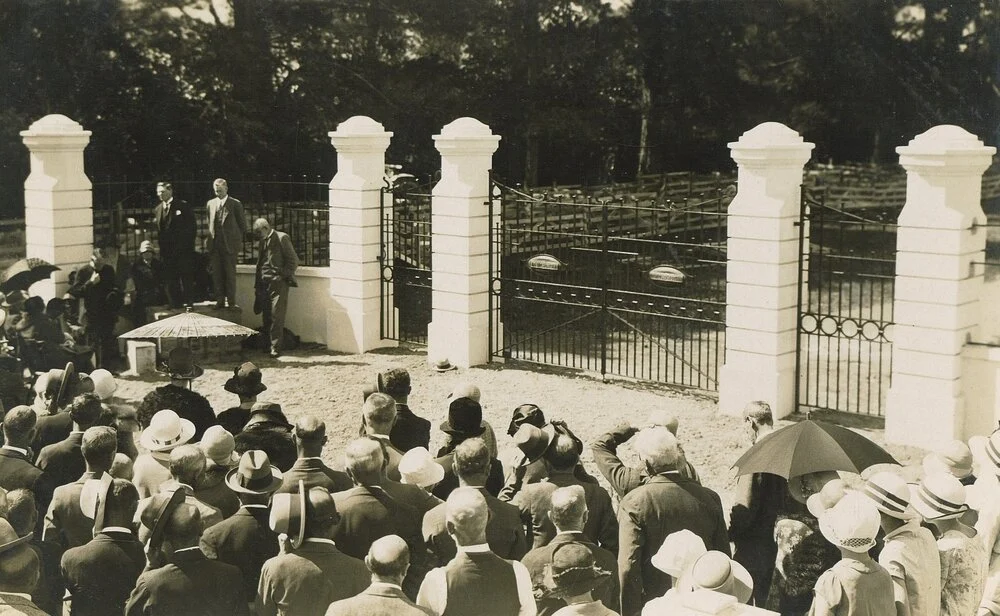
Nearly 100 years after they were unveiled, Richmond’s Washbourn Memorial Gates remain a lasting tribute to a doctor whose service left a deep mark on the community.
In July 1927, Richmond doctor Hubert Oscar Washbourn died unexpectedly, just a week after developing pneumonia.
His death was met with widespread sadness across the district, and tributes flowed in recognition of his service to the Richmond community.
As the initial shock eased, attention turned to finding a suitable memorial. Several ideas were proposed, including a memorial hall, gardens with rest rooms and a set of memorial gates.
Washbourn had a strong interest in agriculture and pastoral pursuits. He bred Jersey cattle and became the first president of the Nelson Jersey Cattle Breeders’ Association. He also served as president of the Nelson Agricultural and Pastoral Association.
Shortly before his death, Hubert had commented that he would like to see the gates at the entrance to the A&P showgrounds improved. In light of that, memorial gates at the entrance were chosen as a fitting way to honour him.
The proposal received financial support from the Nelson A&P Association, supplemented by public contributions. With funding secured, the project moved ahead.
Architects Messrs Houlker and Duke were engaged to prepare a design for the memorial. Their plans were completed by September 1928 and a tender was advertised for construction of the gates.
The project also included provision for a public recreation area. The Nelson A&P Association agreed to transfer a small portion of the showgrounds to the Richmond Borough Council for what became known as Washbourn Memorial Park.
The completed gates were unveiled on 17 November 1928 before a large crowd. Richmond Mayor James Hunt performed the unveiling, and W.D. Harkness formally received the gates on behalf of the Nelson A&P Association.
Set back slightly from the road and arranged in a semi-circular formation, the memorial gates created an imposing entrance to the grounds. The central structure consisted of two wrought-iron carriage gates, each 12ft wide, with a 4ft pedestrian gate on either side. Curved walls extended a further 12ft on each side.
Altogether, the memorial had a frontage of 48ft and incorporated six concrete posts. The posts and walls were finished in white plaster. Bronze shields were fixed to the two carriage gates, one bearing the words "In Memoriam" and the other "Dr H.O. Washbourn".
The gates have now stood at the entrance for almost a century. Over the decades, thousands of people have passed through them, many perhaps unaware of the story behind their construction or of the doctor whose memory they were intended to preserve.
The memorial gates remain a tangible reminder of Hubert and the way the Richmond community chose to commemorate his contribution. After nearly 100 years, however, the gates are showing their age and are in desperate need of care and attention to ensure this piece of Richmond’s history is preserved for future generations.
