
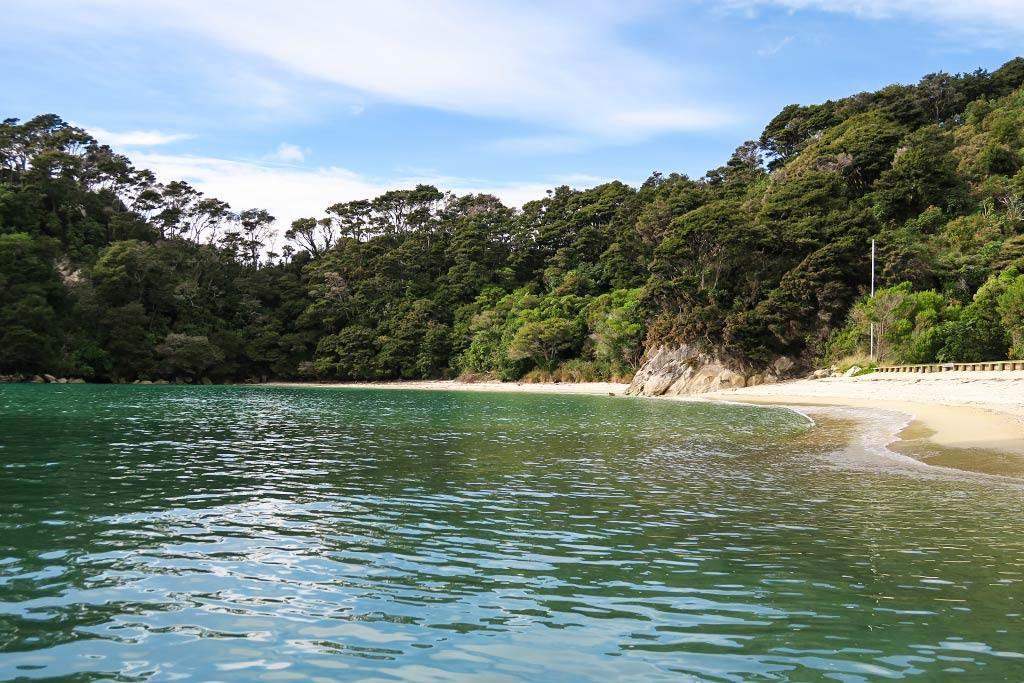
Today, Frenchman’s Bay, within the Abel Tasman National Park, is a quiet coastal inlet surrounded by bush-clad hills and sheltered waters.
In the latter part of the 19th century, however, the bay was used for boat building. During the 1870s and 1880s, its sheltered waters, native timber and easy access to the sea provided ideal conditions for constructing the small sailing vessels needed for the coastal trade of Nelson and Tasman.
Cutters, ketches and schooners were built along this remote stretch of coast by local shipwrights, including William H. Glover.
In 1876, William built a new 17-ton schooner. An experienced boat builder, he undertook most of the work himself. Timber was obtained from the surrounding bush, with his wife helping to gather materials and assist in the vessel’s construction.
When the schooner was completed, she was temporarily rigged for her first voyage to Nelson Harbour. William and his wife sailed the newly-built, and as yet unnamed, vessel from Frenchman’s Bay.
As they approached the entrance to Nelson Harbour, his wife went into labour. William went below to attend to her, leaving the schooner without anyone at the helm. The vessel continued on its course and struck a beacon, damaging her bulwarks before eventually coming to rest on a mud bank.
It was not until daylight that William was able to get ashore and obtain assistance. By then, his daughter had been born.
The schooner entered Nelson Harbour without a name, but William subsequently named her May after his daughter.
William intended the May to trade between West Wanganui and Nelson, carrying goods along the coast. The schooner was one of a number of small vessels that linked isolated coastal settlements with the larger ports of the region.
The story of William and his boat, however, was to end in tragedy.
In May 1877, the schooner was carrying a cargo of hop poles. On a Tuesday morning, while the vessel was underway, William was reefing the mainsail when he was struck by the boom and knocked overboard.
The only other seaman aboard immediately threw out a life jacket, but the sea was heavy and he was unable to reach him. William drowned.
His death brought an end to the life of a man who combined boat building and seafaring with the demands of coastal trade. It was also a poignant end for the builder of the May, the vessel he had constructed with his own hands from timber gathered around Frenchman’s Bay and named after the daughter born during her first voyage.
Another vessel associated with the bay was the Felicity, built in 1885 by Henry Mitchell Burnard.
The 49-foot wooden vessel was described as a ketch, or "blind-bay hooker", a type of shallow-draught vessel suited to working the sheltered waters and bays of the region.
Felicity plied the coast for many years and changed hands several times. About 1902, she was purchased by Thomas Reeves. While sailing from Motueka to Nelson she later turned turtle, lying on her side amid doubts about whether she could be saved.
It was thought the mishap occurred because the vessel had been left on the beach at Motueka for some time, causing seams to open through exposure to sun and rain.
She was repaired, but in 1910 sank off Pencarrow Lighthouse while sailing in heavy seas.
Today, there is little to indicate vessels were once built along the shores of this quiet bay. The surrounding bush has reclaimed much of the landscape, and Frenchman’s Bay is now better known as part of the Abel Tasman coastline.
The records of the May, the Felicity and other vessels, however, provide a glimpse into an earlier period when Frenchman’s Bay was a working place, where local shipwrights used the timber and sheltered waters around them to build the small vessels that served the coastal communities of Nelson and Tasman.
