
When William Plank applied for a bush licence to operate the Wakefield Arms at Waimea South in April 1851, he was establishing what would soon become far more than a place to buy refreshments.
Like many hotels in the early years of settlement, the Wakefield Arms quickly developed into a meeting place, social centre and venue for events ranging from sporting activities and dinners to public meetings and matters of importance to the local community.
During William Plank’s time as publican, the hotel became closely associated with the Wakefield Cricket Club. In April 1852, a match between the married and single members of the club was followed by a dinner provided by William at the Arms. Throughout the cricket season, members regularly returned to the hotel for meetings, social gatherings and dinners.
The Wakefield Arms was also used for more serious matters. In 1853, local residents were summoned to the hotel for the registration and proceedings relating to the selection of a representative for the Waimea district in the Legislative Assembly.
The following year, as winter approached, a public meeting was held at the hotel to discuss measures for repairing roads throughout the district.
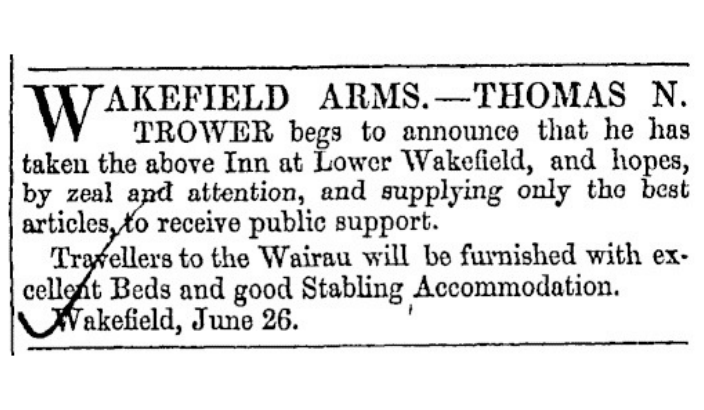
William remained at the Wakefield Arms until about June 1855, when Thomas Trower took over as publican.
Two activities became recurring features of the hotel’s life during these early years: auctions and the arrival of stud horses.
Auctions were regularly advertised at the Wakefield Arms, with goods ranging from livestock, household furniture and farming equipment to properties offered for sale.
The hotel was also one of the places where travelling stud horses were advertised as standing for service. Horses promoted in advertisements included Young Lincoln, Sir Hercules, Black Draught, Leading Article, Greysteel and Criffle.
In late 1855, the Wakefield Arms underwent renovations, including the addition of a large extension. Thomas remained publican until 1857, when the hotel was advertised for rent.
In October that year, Thomas P. Dulling became licensee, although his tenure was brief. By April 1858, notices were being published calling in debts outstanding from the period of his management.
In 1859, David Warnock was granted a licence to operate the Wakefield Arms, and the hotel continued to serve as an important venue for public affairs.
In May that year, members of the council met with local residents at the hotel to consider the proposed construction of a bridge across the Wairoa River.
Later in 1859, the hotel became the birthplace of another local institution. In August, the Mansion of Peace Lodge was formed at the hotel, reportedly the sixth lodge established in the province.
When the lodge celebrated its first anniversary the following year, members formed a procession from the hotel to the church before returning to the Wakefield Arms for dinner in the evening.
The hotel was also drawn into one of the district’s more contentious public disputes in 1860.
Local man Alfred Saunders was charged with criminal libel by William Travers, a judge of the court. The charge arose from comments Alfred made following a case involving himself and Robert Eden.
Robert had taken Alfred to court over a dispute concerning the price of wheat sold by Alfred. William presided over the case and found in Robert’s favour.
Alfred subsequently wrote to a newspaper, claiming the evidence had been incorrectly reported and accusing William of distorting the evidence to support his verdict. The judge responded by filing a charge of criminal libel.
William succeeded in the case and Alfred was sentenced to six months’ imprisonment and fined £150, with further imprisonment threatened if the fine was not paid. The conviction was the first for criminal libel in the district.
The severity of the sentence caused considerable public concern and meetings were quickly organised to discuss the matter. Among the venues chosen for these gatherings was the Wakefield Arms.
By this time, the hotel had firmly established itself as one of the district’s principal gathering places.
