
William Lane was a well-known resident of Motueka and Riwaka whose working life spanned photography, building, plumbing, decorating and electrical work.
Born in Kensington, London, about 1862, William completed his schooling before working in the plumbing and house decorating trades. He later travelled to South Africa, visiting Cape Town and then Rhodesia, where he took up photography. During the Boer War, he served with the Field Artillery.
After leaving Africa, William moved to Australia and spent periods living in Sydney and Brisbane before coming to New Zealand. He lived in Dunedin and Wellington, where he built several residences.
Following a visit to Nelson, William settled in Riwaka, where he met and married Henrietta Askew. Henrietta was the daughter of Peter and Elizabeth Askew and was born in Riwaka. The couple had one son, William Keith Lane.
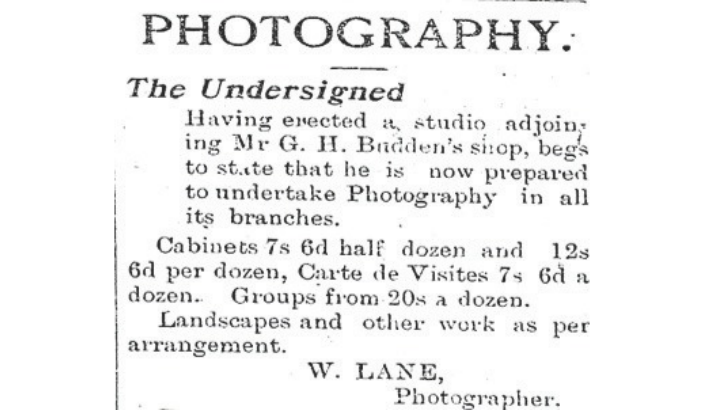
William built the family home in Riwaka and, in 1905, established a photography studio beside the house, advertising the opening of his new business. He developed a particular interest in landscape photography, capturing coastal and scenic locations throughout the Nelson district. At one stage he travelled to Wellington to promote both his photographs and the region's scenery.
In early 1907, William photographed the Riwaka limestone caves and became involved in organising visits for people wanting to explore them.
By late 1908 William had expanded his business interests to Motueka, building a shop in High Street. From the premises he operated a painting, paperhanging and signwriting business. His work included the complete decoration, painting and varnishing of the new home of John Rowling in 1910.
Throughout his life William worked across a range of trades. Alongside painting, decorating and photography, he also worked as a sanitary plumber, gas and hot-water fitter, electrician and radio repairman.
In late 1917, concerns about the sanitary facilities at Motueka School were raised with the Minister of Education, who described the conditions as a "menace to the health of the children". William secured the contract to remedy the problem at a cost of £250.
Outside work, William played an active role in the community and sporting life of both Motueka and Riwaka. During the war years he supported returning soldiers and was later made a life member of the Motueka branch of the Returned Soldiers’ Association.
A keen sportsman, William had a particular interest in bowling, tennis and football. He was one of the original members of the Motueka Bowling Club and was later made a life member. William donated the Lane Singles Championship Cup and actively encouraged younger bowlers.
He also served as patron of the Central Tennis Club in Riwaka and was a life member of the Wanderer and Tikaokao football clubs.
William remained active in his work and in the sporting and social life of Motueka and Riwaka until his health began to deteriorate about 18 months before his death in July 1934, aged 72.
