
The conviction of Alfred Saunders at the Wakefield Arms sparked strong community support across Wakefield and Spring Grove.
A public meeting was arranged to allow residents to express their sympathy for Saunders and consider ways to secure a reduction in his sentence. After 1,077 signatures were collected throughout the Waimeas, a petition was sent to the Governor. A pardon was granted and Saunders was released after spending three months in jail.
The Waimea South Volunteers met at the hotel in March and April 1860 to enrol members and nominate a captain and two lieutenants.
By mid-1861 the Wakefield Arms was available to lease and Joseph Andrews became publican. During his time at the hotel, he suffered a devastating personal tragedy when three of his young children died from diphtheria.
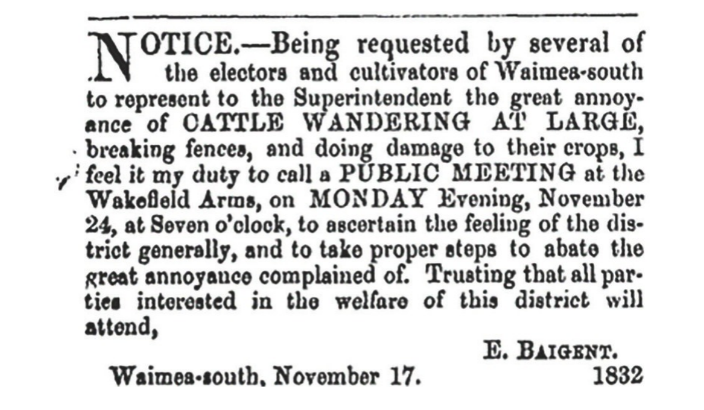
In November 1862, concerns were raised about cattle wandering at large, damaging fences and crops. E. Baigent organised a public meeting to discuss possible solutions.
What followed was a lively and fiery debate over a proposal to petition the Superintendent to proclaim a Cattle Impounding Ordinance in Waimea South. Some settlers believed the move would disadvantage those who grazed cattle on unenclosed land while favouring a small number of large landholders.
A memorial was eventually drawn up requesting the Superintendent proclaim part of the district for protection against wandering stock. The proposed area covered the trunk line and a quarter-mile on either side, from the crossroads by Currin's at Maddox Bush to the water splash near Mr Griffith's in Upper Wakefield.
Joseph Wagstaff became publican in June 1867 and was in residence when one of the district's most exciting events began. The first Waimea Steeplechase was held in February 1868, with the Wakefield Arms at the centre of the action. The Waimea South Jockey Club continued to hold its meetings at the hotel.
Wagstaff departed and James Plank became publican about October 1869. In April 1872 the hotel was again advertised for lease. The advertisement continued to appear for several months, suggesting James remained in residence. Evidence of this came in early 1874 when he auctioned his stock, feed and household furniture, including toilet sets and covers, spittoons, bar fittings and poultry.
A new publican was eventually found when R. Chamberlain arrived in mid-1874. By December, however, he appears to have left and was replaced by Frederick Day.
In September 1876, Day was taken to court by lessee William White, a brewer, over £10 in unpaid rent and a further £10 in damages. White claimed Day had refused to sell beer supplied between July and August. Day was forced to leave the hotel and was replaced by Robert Wallace.
Wallace's tenure also led to legal action. In April 1877, White successfully recovered £14 6s 6d for beer supplied to him.
Wallace remained at the Wakefield Arms until March 1879 when, with the lease due to expire, he auctioned the hotel's contents. The property was offered for sale the following month.
In 1882, the old building underwent a complete change of purpose. It was purchased by Rev. Thomas Bowden, who established the Brierly Farm Academy as a private school. The venture was short-lived and Thomas later converted the building into a private residence, where he remained for the rest of his life.
