
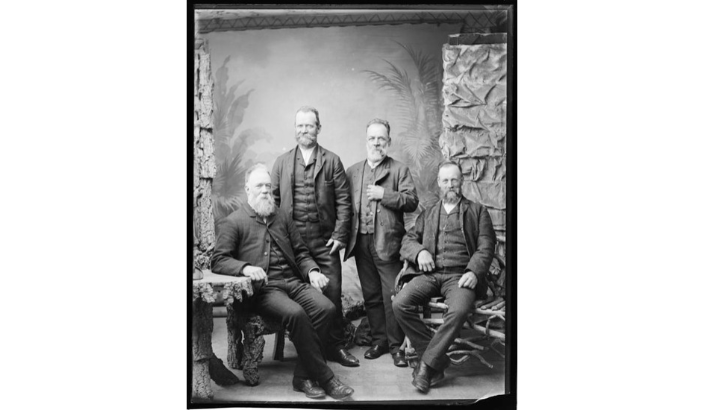
Puramahoi, a small settlement in Golden Bay, was established among pastoral land, wetlands and coastal areas.
By 1855, immigrants had begun settling in the district, with the Walker family becoming prominent among the early residents.
Isaac Walker arrived in Nelson in 1842 at the age of eight with his parents, John and Sarah Walker. About 1853, the family moved to Motupipi, where Isaac's father managed a coal mine. By 1858, Isaac had moved to Puramahoi, where he and several family members took up farming.
Isaac was joined in the district by his parents and older brother John. John later became a captain and was involved in the shipping trade between Nelson and Golden Bay.
Isaac married Maria Coombs in 1855 and the couple had five children: James, Clara, Mary, Jane and Edwin. Maria died in 1870 and, three years later, Isaac married Jane Sanders. They had three children: Harriet, Hester and Mabel.
In 1878, the Walker family built a new house. During the move from the old home to the new one, Sarah suffered a serious accident while crossing a small creek.
The crossing was made by means of a tree trunk and, while passing over it, she fell onto a sharp projecting branch which entered her abdomen.
With no nearby means of communication, assistance was sought through Motueka, where the telegraph station could be accessed.
The difficulties faced by the Walker family were shared by other families living in the isolated settlement. Education was important to local children and, in August 1882, the Walkers and other residents requested the establishment of an aided school in Puramahoi.
The request was unsuccessful, but a further application was made two years later.
The family suffered a double bereavement in 1884, with Sarah dying in November, followed by John in December.
As the settlement developed, social gatherings provided an important opportunity for residents to come together.
In November 1894, Puramahoi residents organised a concert and dance to raise funds for an organ. Daniel Walker's wife was among those involved in organising the event, with hopes a large crowd from outside the district would attend.
Improved roads were another longstanding concern. After many years of requests, tenders were called in September 1898 for the construction of an inland road from Takaka to Puramahoi. The successful tenderers were Hunter and Beardmore.
Jane died in July 1900.
In March 1909, Isaac sold his farm to Mr F. W. Falconer, of the cheese factory at Collingwood. Falconer intended to establish a cheese factory at Puramahoi and, by September, the venture was underway.
The cheese factory was officially opened, showcasing a new building measuring 70 by 24 feet and capable of processing milk from about 500 cows.
By 1912, Puramahoi was experiencing further growth. The cheese factory had given the district a strong start, while the later establishment of Grant Brothers' sawmill brought another industry to the area.
The community had also developed a number of local institutions and activities. Puramahoi had a tennis club with its chip court, a football club, a school and a new public hall, which opened in May.
After many years as one of the district's established residents, Isaac was formally farewelled by the people of Puramahoi in May 1913 when he left the district to live in Nelson.
The Walker family's story reflects the development of Puramahoi from an early farming settlement into a growing rural community. From the arrival of the first families to the establishment of the cheese factory, sawmill and community institutions, the district gradually developed the facilities and industries that supported its growing population.
