
The Hiawatha Tennis Club played a pivotal role in the growth of tennis in Golden Bay, evolving from modest beginnings in 1908 to become one of the district's leading sporting organisations.
At the start of the 1908 tennis season, a newly-formed team competing under the Hiawatha Tennis Club banner joined clubs from Upper Takaka, Uruwhenua, East Takaka, Waitapu and Lower Takaka. Lacking a home court of its own, the club secured the use of Hugh Page's private courts for practice and competition.
By 1910, plans were underway to establish two asphalt courts on the Bowling Club grounds through a lease agreement. Completion was targeted for Christmas, provided sufficient funds could be raised. To achieve that goal, the club organised a monster bazaar.
Within two years, the new courts had deteriorated and required resurfacing, prompting another large fundraising bazaar to cover the costs.
The club continued to grow and by the opening of the 1913 season had become the leading tennis club in the district. Club president J.B. Sadd officially opened the courts that year, recalling how the organisation had progressed in just four years from a single chip court to three asphalt courts.
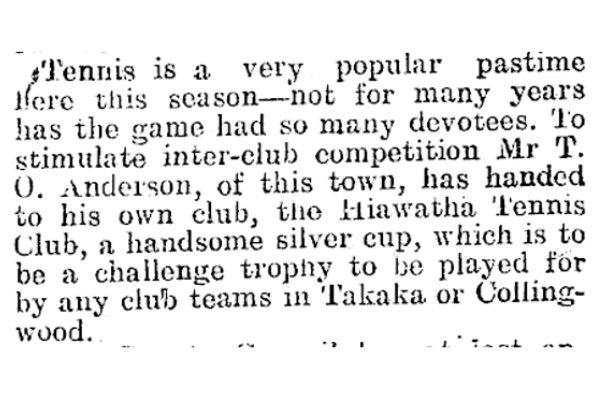
Tennis flourished throughout Golden Bay, with strong rivalries developing between local clubs. Takaka resident T. Anderson donated a silver challenge trophy, known as the Anderson Cup, to be contested by teams from Takaka, Hamama and Collingwood.
Hiawatha successfully defended the trophy against numerous challenges until the end of the 1919 season, when Collingwood claimed the cup. Hiawatha then travelled to Collingwood to try to win it back but found the home side difficult to beat on its own courts.
Competition rules stated the club holding the cup on March 31 would be declared the season's winner. As a result, the trophy was engraved "Collingwood 1919-20", although Hiawatha regained possession the following year.
By 1921, the number of tennis clubs in the bay had grown to seven and a new Lawn Tennis Association was established to oversee the game locally.
To maintain public interest and showcase the sport, Hiawatha hosted an all-day representative match between teams of eight men and eight women from Motueka and Golden Bay. After a full day of competition, Golden Bay emerged victorious.
Tennis continued to expand throughout the district and new clubs regularly joined local competitions. In 1927, the Tarakohe club challenged Hiawatha for the Anderson Cup, by then widely regarded as the district's premier tennis trophy.
The Easter tournament that year attracted a record number of entries, with Hiawatha player Connie Grooby winning the women's singles title for the sixth consecutive year.
Like many sporting organisations, the club relied heavily on fundraising. In 1928, it organised a tennis fete featuring games, ping pong, throwing the beans, quoits, candle lighting, a fishpond and afternoon tea. Proceeds were used to improve the club's facilities.
In 1936, the club was offered the opportunity to extend its lease for a further 10 years, effectively securing the site for 20 years. Members ultimately decided against taking up the option, believing the commitment was too long. The club therefore retained a 10-year lease without renewal rights.
Although Hiawatha continued to enjoy success, the structure of tennis in Golden Bay gradually changed. The sport evolved from a collection of small township clubs into a more centralised model, paving the way for the formation of the Golden Bay Tennis Club.
