
Until the late 1850s, Collingwood was served by travelling missionaries. Following the discovery of gold in the Aorere Valley in 1857, the town’s population grew as miners flocked to the district.
Concerned the growing community lacked a permanent minister, the Bishop of Nelson, Edmund Hobhouse, appointed his former curate, the Reverend R H Codrington, to the Golden Bay goldfields in 1860. Codrington supported the establishment of a permanent church and secured the land on which St Cuthbert’s Church now stands.
Despite the establishment of a building fund by Codrington’s successor, the Reverend Halcombe, the gold rush was short-lived and little progress was made towards constructing the church. Halcombe held services in the local schoolhouse but, after becoming unwell, requested release from his position in September 1870 once a replacement minister could be found. Before leaving, he secured promises of support for a church at Collingwood, with the building fund reaching about £183.
The Reverend Richard Gaskin was subsequently appointed and considered a new church essential to the community. However, he drowned in September 1872, and another two years passed before a minister was appointed.
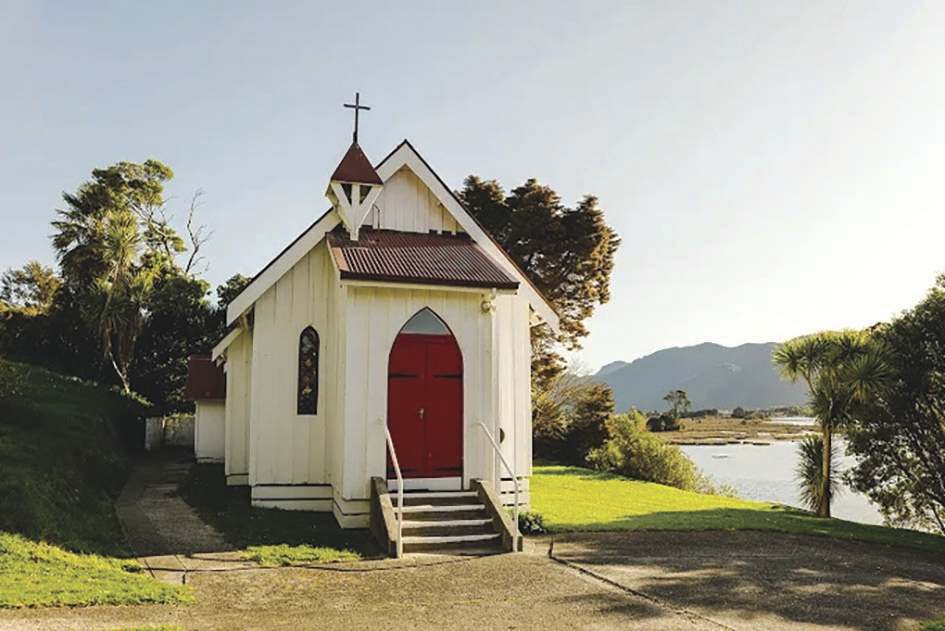
Thomas Brunner, who trained as an architect and surveyor in England, designed St Cuthbert’s Church shortly before his death in 1874. The church was built by Mr Grange for £140 and, on completion in 1873, was described as “one of the best-built churches in the diocese”.
The building was a simple pit-sawn timber structure with a small turret bell tower. Its rectangular plan included two projecting bays on each side of the nave. Lancet windows at the western end and trefoil windows along the side walls were donated by the Bishop of Nelson, Andrew Suter. The pitched roof was covered with shingles.
When construction was completed, it was discovered part of the church stood on adjoining land rather than entirely within the church property. The opening was delayed until the strip of land on which the building encroached could be purchased. St Cuthbert’s Church eventually opened before the end of 1873.
The church quickly became an important centre for the spiritual and social life of Collingwood, hosting services and community events. In December 1882, the Collingwood Choral Society held an evening of entertainment, with all proceeds going towards church funds.
Christmas was a particularly significant occasion. In 1884, the church was decorated with nīkau palms, ferns and flowers for a full choral service featuring carols and choir performances. The following day the congregation held a church bazaar, for which preparations had been underway for several months. The event raised £45 and, along with other promised contributions, was expected to clear the church’s debt.
By 1900 St Cuthbert’s required painting, and the Ladies Guild organised a Sale of Work in Collingwood Hall to raise funds. The event featured stalls selling homemade items, donated goods and refreshments, alongside lantern-picture displays, a gypsy corner, readings, an exhibition of antiques, children’s singing and a home-cooking competition.
A garden party was also organised in February that year to raise money for the parsonage building fund.
Through the dedication of its clergy and congregation, St Cuthbert’s Church developed from a long-awaited place of worship into the heart of community life in Collingwood. Its construction, fundraising efforts and social gatherings reflect the determination of local residents to establish and maintain a permanent church during the district’s early settlement years.
